
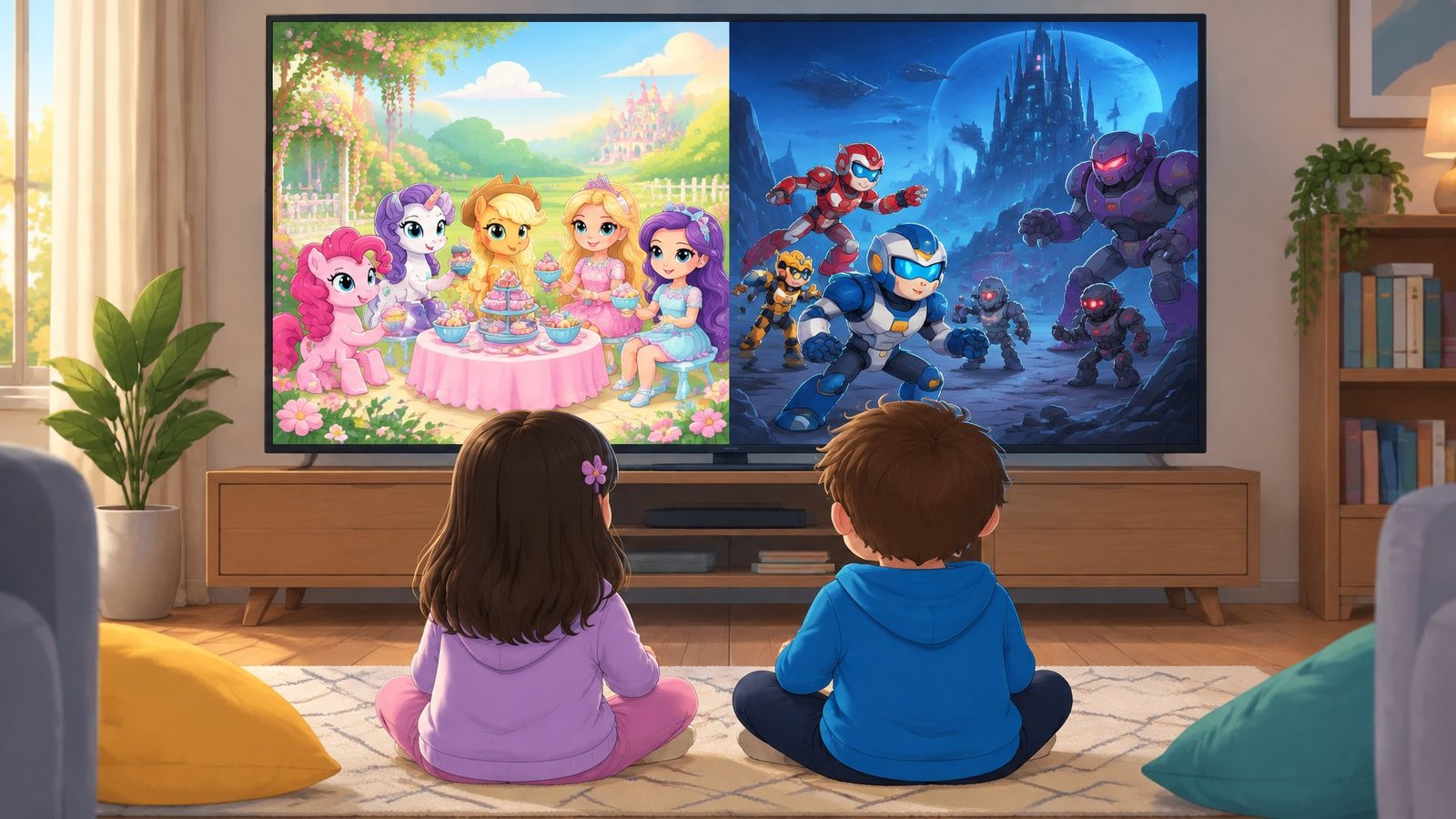
Cartoons built to sell toys to girls talk about sweets far more than cartoons aimed at boys. In more than a thousand hours of toy-linked shows and films, words for candy, cake and other sweets came up about 8.4 times as often in girls’ programs as in boys’ programs.
The study comes from marketing researchers Eric Setten of California State University, Fullerton, and T. Bettina Cornwell of the University of Oregon. It was published online in the Journal of Consumer Affairs on December 16, 2024 (read the paper).
The authors call these programs “toy-tied media”: series, movies and webisodes whose characters are also sold as toys, from My Little Pony to Transformers. Advertising junk food to children is restricted in several countries, they note, but nothing governs the food that appears inside the stories themselves.
Baking for friends versus fighting villains
The first study was a close viewing of 24 episodes from eight Netflix series that toy makers market to one gender. The boys’ shows were Lego Ninjago, Marvel’s Avengers Assemble, Star Wars: Clone Wars and Transformers: Rescue Bots. The girls’ shows were Barbie: Life in the Dreamhouse, Lego Friends, Littlest Pet Shop and My Little Pony: Friendship Is Magic.
Two trained coders agreed on 95% of their ratings. In the girls’ shows, food was woven into the plots: characters baked, ran food businesses and gave treats to show they cared, and sweets were usually the food at the center. In the boys’ shows, violent conflict filled the screen time and food rarely mattered to the story. Fast food was less common than sweets in both groups.
Counting food words in 5 million spoken words
The second study scaled up. The researchers asked 248 American parents whether the toys from 78 franchises were for girls, boys or both. They then gathered 2,333 transcripts covering 1,041 hours of video and more than 5 million spoken words, and counted words from custom dictionaries of sweets, fast food and vegetables, plus established word lists for home life, eating, violence and weapons.
After adjusting for age group, format and other factors, girls’ programs carried sweets words 8.37 times as often as boys’ programs, and gender-neutral programs 3.83 times as often. Words about eating appeared 2.37 times as often in girls’ shows and words about home life 2.18 times as often, while weapon words appeared about half as often.
The age ratings pointed the same way. Shows rated suitable for children six and under used sweets words about five times as often as shows rated for viewers seven and older. The authors argue this is a side effect of rating systems built around violence: when fighting is off the table, plots lean on other themes, and treats fill the gap.
What the transcripts cannot show
The authors list clear limits. The large study only captured food that characters say out loud, and earlier research found that 35.1% of food cues in children’s media are visual only. Both studies are descriptive, so they do not show that watching these shows changes what children eat, and they do not explain how studios decide to put so many sweets into girls’ stories.
They suggest food depictions could one day sit alongside violence and language in parental guidance ratings. For now, a girl watching these shows hears about sweets roughly eight times as often as a boy watching his.
Study Details:
- Title: Sugar coating cartoons for girls: Gender stereotypical themes and the use of food in toy-tied media
- Authors: Eric Setten, T. Bettina Cornwell
- Journal: Journal of Consumer Affairs
- Publication Date: December 16, 2024
- DOI: 10.1111/joca.12613