
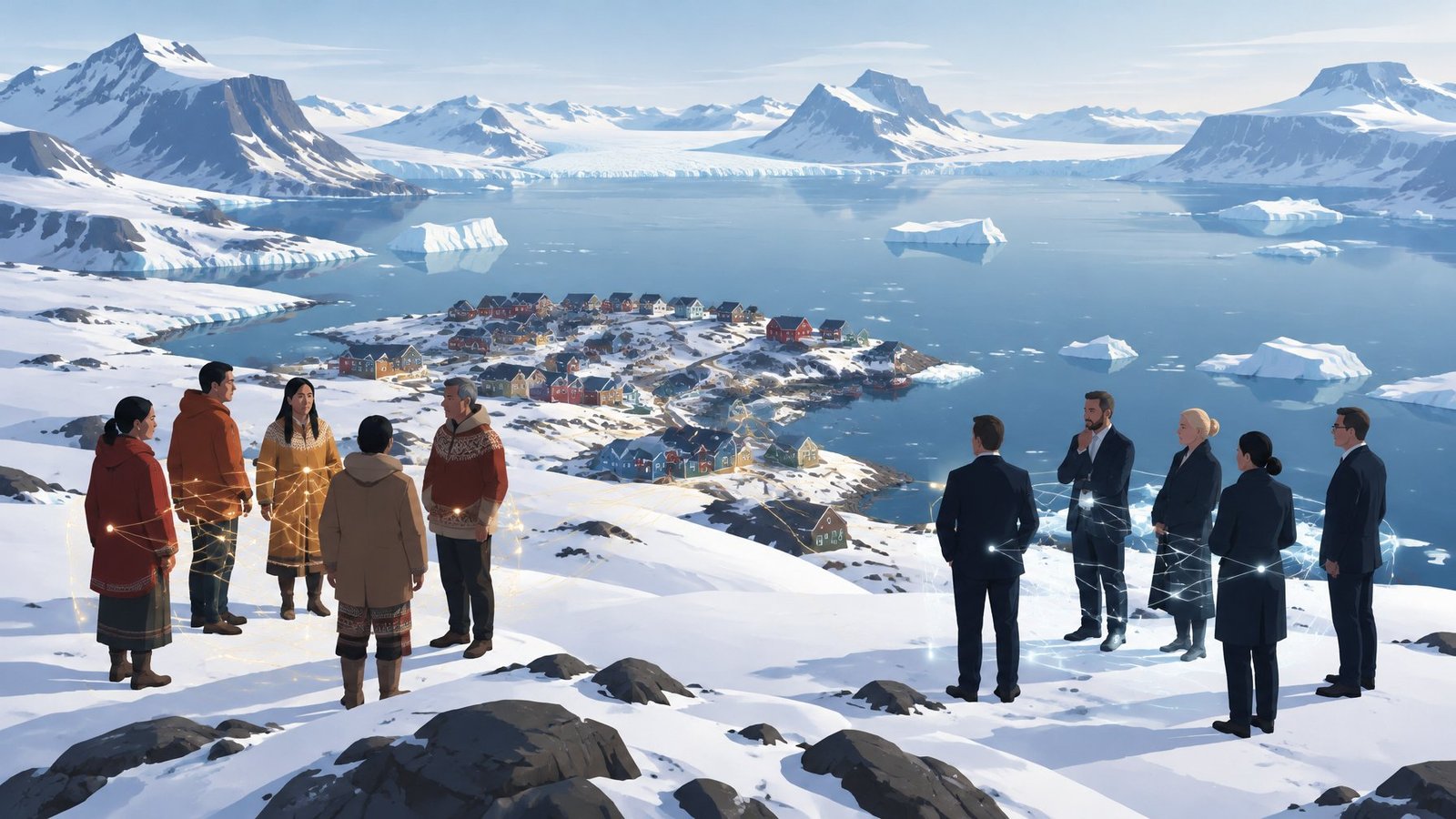
Greenland is run by a tight circle of just 123 people, and it is politicians and the state, not private business, that dominate it. But that circle has a visible fault line: every politician in it has childhood or educational roots in Greenland, while about half of the other members do not.
The mapping comes from sociologists Morten Fischer Sivertsen and Christoph Houman Ellersgaard of Copenhagen Business School and Anton Grau Larsen of Roskilde University. Their research note, “The Power Elite in Greenland,” was published online in the British Journal of Sociology on June 4, 2025, as US interest in buying the island made headlines.
How the researchers found the inner circle
The team collected every formal membership list they could find for potentially powerful bodies in Greenland: companies, state-owned enterprises, the civil service, political parties, municipalities, unions, business associations, civil society groups and academia. The data, gathered between February 1, 2019 and February 1, 2020, covered 3,412 positions held by 2,052 people in 456 organisations.
They then used a network method called k-circle analysis, which repeatedly peels away the less connected people and organisations until only the most interlinked core remains. That core held 123 individuals, each with at least two positions in 79 tightly connected organisations. The researchers gathered background data on all of them and interviewed six members of the elite.
Politicians and state companies outweigh business
Politicians were the largest group, 34 of the 123 (28%), drawn from the government, parliament, city mayors and party leaderships. There were 24 private business leaders (20%), 22 senior civil servants (18%) and 21 executives of state-owned enterprises (17%). Interest organisations supplied 14 members (11%) and science and education 8 (7%).
Denmark looks very different. In its 2017 power elite, 43% were private business leaders, while politicians and senior civil servants made up only 10% each. Greenland’s elite is less driven by corporate interests and more by political and state power, including the state-owned companies.
Women made up 38% of the Greenlandic elite, against 26% in Denmark. But they sat mainly in politics and administration. In private business, only two of 22 classified members were women.
A split along Greenlandic and Danish lines
Overall, 72 members (59%) were born or educated in Greenland, 48 (39%) were not, almost all of them of Danish origin, and 3 could not be classified. The political elite was entirely Greenlandic by that measure, while the private sector was clearly dominated by people without formative ties to the island.
Education split the groups too. Only 5 of the 34 politicians (15%) had degrees in economics, law and administration or engineering and natural sciences, against 53 (60%) of the other members. Most politicians came from welfare professions or vocational training. Business figures were also more likely to be men and to live in the capital, Nuuk.
In interviews, senior civil servants described politicians as “opportunistic” and “not always rational.” The authors see the bureaucrats as the link between all-Greenlandic politicians and a largely Danish private sector, and they warn that this ethnic divide could weaken the elite’s cohesion and legitimacy as it responds to American overtures.
They are open about the limits. Formal positions miss the informal ties and kinship networks that matter in a society of fewer than 60,000 people, and the data predate recent changes, such as more Greenlanders reaching top state jobs. Their sharpest example of the tension is concrete: a 2024 fisheries law seen as favouring large fishing firms over small coastal fishermen, which the new coalition chose not to revise after the March 2025 election.
Study Details:
- Title: The Power Elite in Greenland
- Authors: Morten Fischer Sivertsen, Anton Grau Larsen, Christoph Houman Ellersgaard
- Journal: British Journal of Sociology
- Publication Date: June 4, 2025
- DOI: 10.1111/1468-4446.70002