
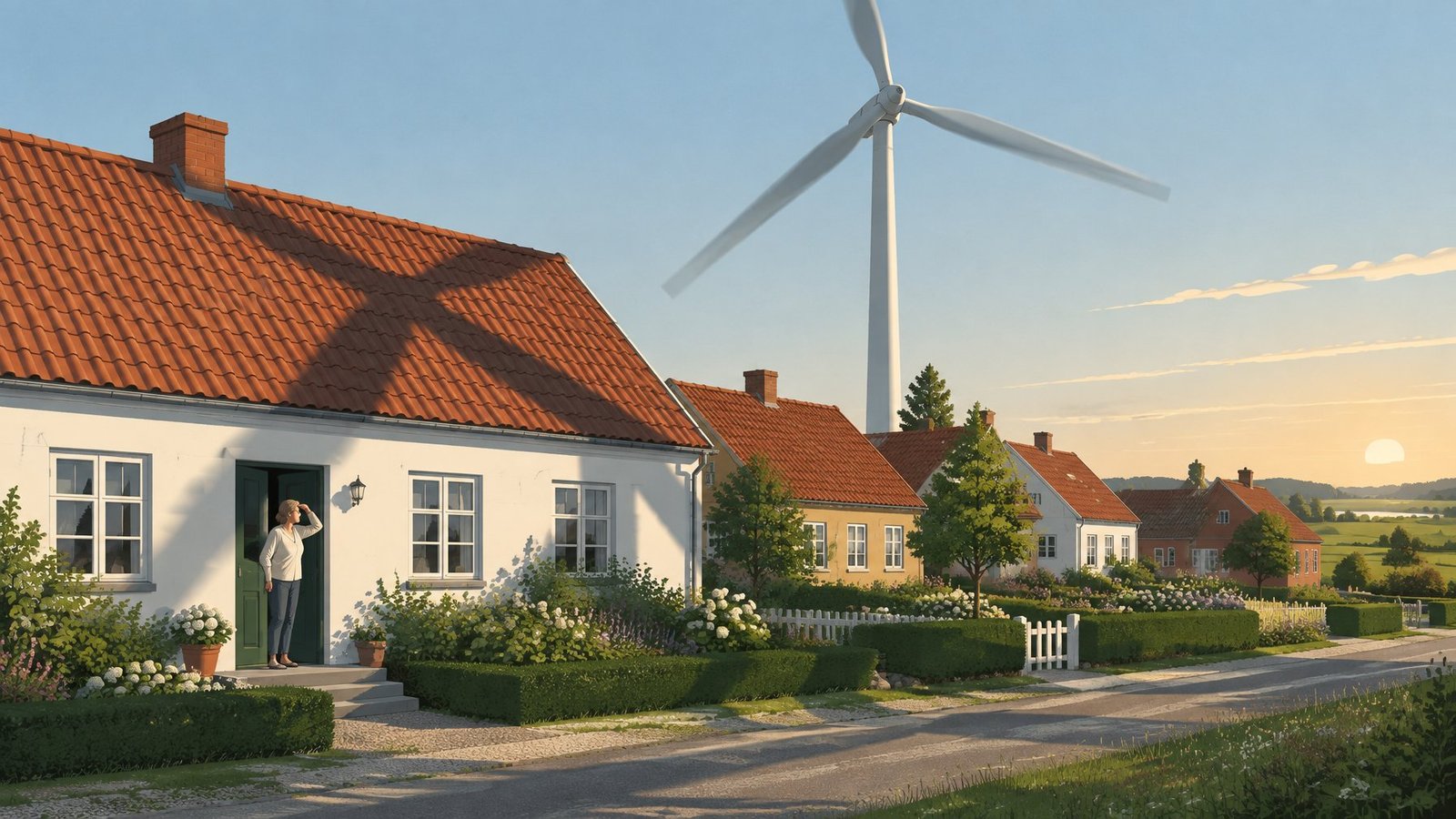
Living near a wind turbine costs Danish homeowners money, and the bigger the turbine, the bigger the loss. Homes that also sit in the path of the flickering shadows cast by turning rotor blades lose even more.
Those are the findings of Carsten Andersen and Timo Hener, economists at Aarhus University in Denmark. Their study was published online in Environmental and Resource Economics on February 11, 2025, and appears in the March 2025 issue.
Every house sale and every turbine in Denmark
Denmark is an unusually good place to study the question. The authors combined data on 2.4 million house transactions since 1992 with records of all 6,878 onshore wind turbines that operated in the country between 1977 and 2019.
Because the period is so long, many homes were sold more than once. That let the researchers compare the same house before and after a turbine went up nearby, or after one was taken down, which rules out fixed differences between homes that happen to be near turbines and those that are not.
They measured two separate things. Proximity is simply the distance from house to turbine, which captures noise and the view. Shadow flicker was calculated house by house, by checking whether the sun is ever blocked by the rotor blades as seen from each property.
Size and position matter
The published results show strong negative effects on prices, with reductions of up to 12% for modern giant turbines. In the authors’ analysis, turbines shorter than 60 meters had no effect on house prices. Giant turbines of 120 meters and more hit hardest, and their effect faded only slowly with distance, disappearing after about 5 kilometers.
Shadow flicker carries its own penalty. Homes that experience it lose an additional 8.1% of their value, on top of the effect of being close to a turbine.
Still worth building, the authors argue
The study does not conclude that turbines are a bad deal. Weighing the house price damage against the value of the carbon dioxide emissions the turbines avoid, the authors find that wind turbines, especially newer tall ones, mostly outweigh their local costs at conventional estimates of the social cost of carbon.
Their policy advice follows from that. Compensation for homeowners should take into account distance, turbine height and shadow flicker together. Strict distance rules based on a multiple of turbine height overlook that turbines remain beneficial even in fairly populated areas.
And placement can do a lot of the work. Because the flicker penalty is so large, siting turbines so their shadows miss homes greatly improves the balance between local damage and social benefit.
Study Details:
- Title: Wind Turbines, Shadow Flicker, and Real Estate Values
- Authors: Carsten Andersen, Timo Hener
- Journal: Environmental and Resource Economics, pages 731-759
- Publication Date: February 11, 2025
- DOI: 10.1007/s10640-024-00947-x