
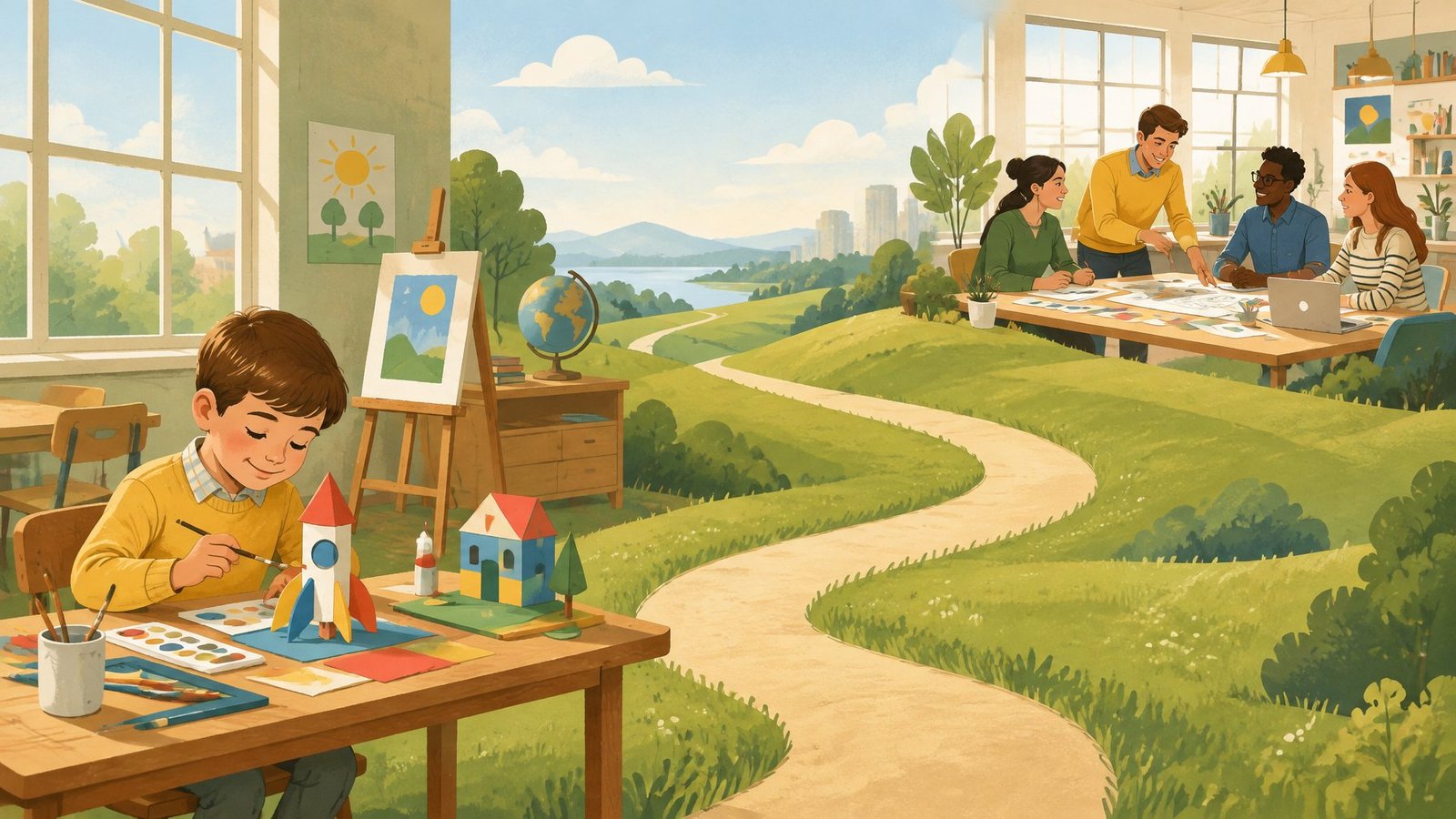
Creative children do better in life, according to a long-running study that tracked thousands of Britons from the age of seven into adulthood. Those judged more creative as children went on to earn more over their careers, work in higher-level jobs and reach higher levels of education.
The research is by David Gill and Victoria Prowse, economists at Purdue University. It appeared in the August 2024 issue of the Journal of Political Economy Microeconomics, building on a working paper first circulated by the IZA Institute of Labor Economics in May 2021.
A lifetime of data from one week in 1958
The authors used the National Child Development Study, which has followed almost everyone born in England, Scotland and Wales in the first full week of March 1958. After exclusions, their sample held 12,211 people.
At age seven, each child’s teacher evaluated their creativity. Because that rating came long before decisions about school subjects, college or careers, later choices could not have shaped it. The researchers also controlled for detailed information about each child’s parents, home and school, and for cognitive ability measured through math, reading and general ability tests. To deal with teachers misjudging children, they estimated each teacher’s evaluation error by comparing their ratings of math and reading with test scores.
The authors argue creativity matters more as automation spreads, because it is essential to open-ended problem solving and hard for computers to replace.
Higher pay, better jobs
In the working paper version, among people in work, one standard deviation more childhood creativity was linked to earnings around 2% higher. The same increase came with a rise of nearly one percentage point in the chance of being in work at all.
Creative children also ended up in better jobs. One standard deviation more creativity was associated with a two-percentage-point higher chance of working in managerial and technical occupations, where 38% of the sample worked, and a nearly two-point lower chance of skilled non-manual work.
Cognitive ability showed a different pattern. It predicted working in professional occupations, the top category, while creativity did not.
Education followed suit. One standard deviation more creativity was linked to a three-point higher chance of passing O-level exams at 16, and one point higher chances of A-levels at 18 and a university qualification by 23. For this cohort, only 16% gained A-levels and 12% a university qualification.
A package of practical skills
The study also looked at what creative people are like. More creative individuals said they had been better at art, music, woodwork and sports at school, and reported stronger practical skills as adults, such as construction and assembly, selling and caring for others. They were also more likely to work in jobs that require experience.
More cognitively able people, by contrast, reported strength in math and science and in analytical tasks such as calculations and finance, and were more likely to hold jobs requiring formal qualifications. The authors conclude that creative people have a package of practical skills that helps them thrive where learning from experience is important.
They note that the payoffs they measure understate creativity’s value to society, since consumers and firms capture some of the benefits and creative ideas build on each other over time. Their suggestions include making learning more practical and experiential, and building the confidence to pursue unconventional ideas despite skepticism.
Study Details:
- Title: The Creativity Premium: Exploring the Link between Childhood Creativity and Life Outcomes
- Authors: David Gill, Victoria Prowse
- Journal: Journal of Political Economy Microeconomics
- Publication Date: August 2024
- DOI: 10.1086/730453