
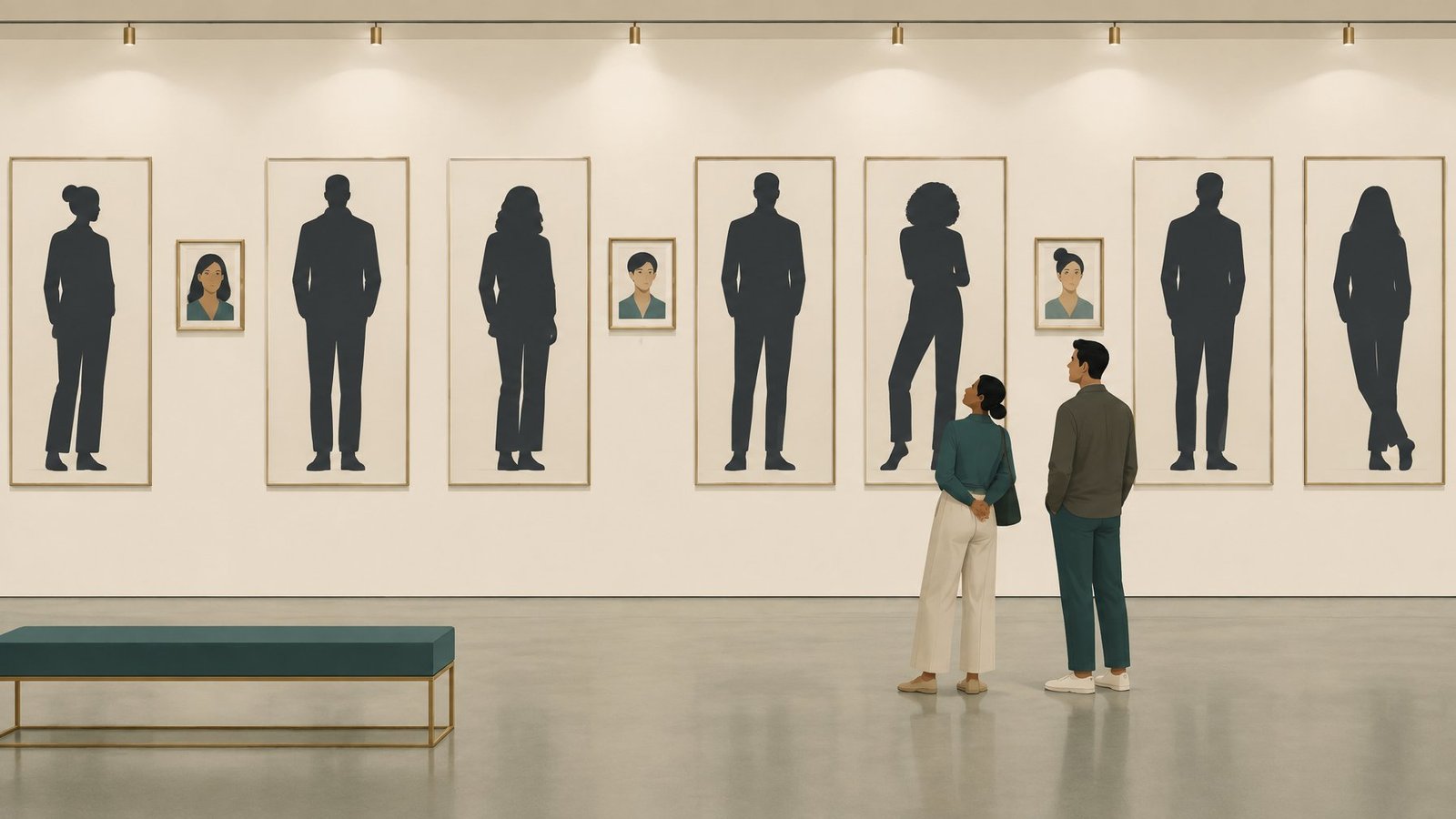
Strangers can guess whether someone is rich or poor from a single photo, and the body gives more away than the face. In a series of studies, people sorted photos by social class better than chance, and they were most accurate when they could see the person’s body, even as a plain black silhouette.
The research was carried out by R. Thora Bjornsdottir of the University of Stirling and Royal Holloway, University of London, Paul Connor of the Stevens Institute of Technology and Nicholas O. Rule of the University of Toronto. It was published online on June 13, 2024, in the Journal of Personality and Social Psychology.
Bodies drive status judgments, faces drive warmth
The first studies used a database of photos in which faces had been digitally attached to different bodies, so that each face appeared on several bodies and each body under several faces. Nearly 1,200 undergraduates rated 25 such composite figures on 24 characteristics. Because faces and bodies were mixed and matched, the researchers could measure how much of each impression came from the face and how much from the body.
Bodies mainly drove judgments of competence, conscientiousness, dominance and social class. Faces mainly drove judgments of age, honesty, political orientation, sympathy and warmth. Attractiveness and broad personality traits drew on both. A second study with about 3,000 participants, including university students and adults recruited through Prolific, pointed the same way.
Guessing rich or poor
The team then asked whether those impressions are accurate. They photographed 160 people, half from higher-income and half from lower-income households, once in a neutral pose and once in a spontaneous one. Some 290 North American participants were shown either faces only, bodies only or whole persons and asked to sort each one as rich or poor.
On an accuracy scale where 0.50 is pure guessing, faces scored 0.54, whole persons 0.61 and bodies 0.63. Seeing the face on top of the body added nothing. Faces in the spontaneous, expressive photos gave no usable signal at all, consistent with earlier work showing that emotional expressions mask social class.
To pull apart what in the body carries the signal, a further study turned the body photos into black silhouettes or into rectangular cutouts that showed only fabric and clothing detail. Silhouettes scored 0.59 and clothing cutouts only 0.52. Silhouettes of men were read more accurately than those of women, at 0.64 versus 0.56.
A final analysis looked at which cues in the silhouettes mattered. Richer people’s silhouettes were rated as more attractive, and observers used attractiveness to make their call. An expansive, dominant-looking posture did not differ between rich and poor, though observers still treated it as a sign of wealth in men.
The authors note that they could not fully separate body shape, posture and the cut of clothing, and that their participants and photographed targets were North American. They also point out that the finding that shape mattered more than clothing details runs against recent theory placing clothing at the center of class perception.
Study Details:
- Title: Social Judgments From Faces and Bodies
- Authors: R. Thora Bjornsdottir, Paul Connor, Nicholas O. Rule
- Journal: Journal of Personality and Social Psychology
- Publication Date: June 13, 2024
- DOI: 10.1037/pspa0000397