
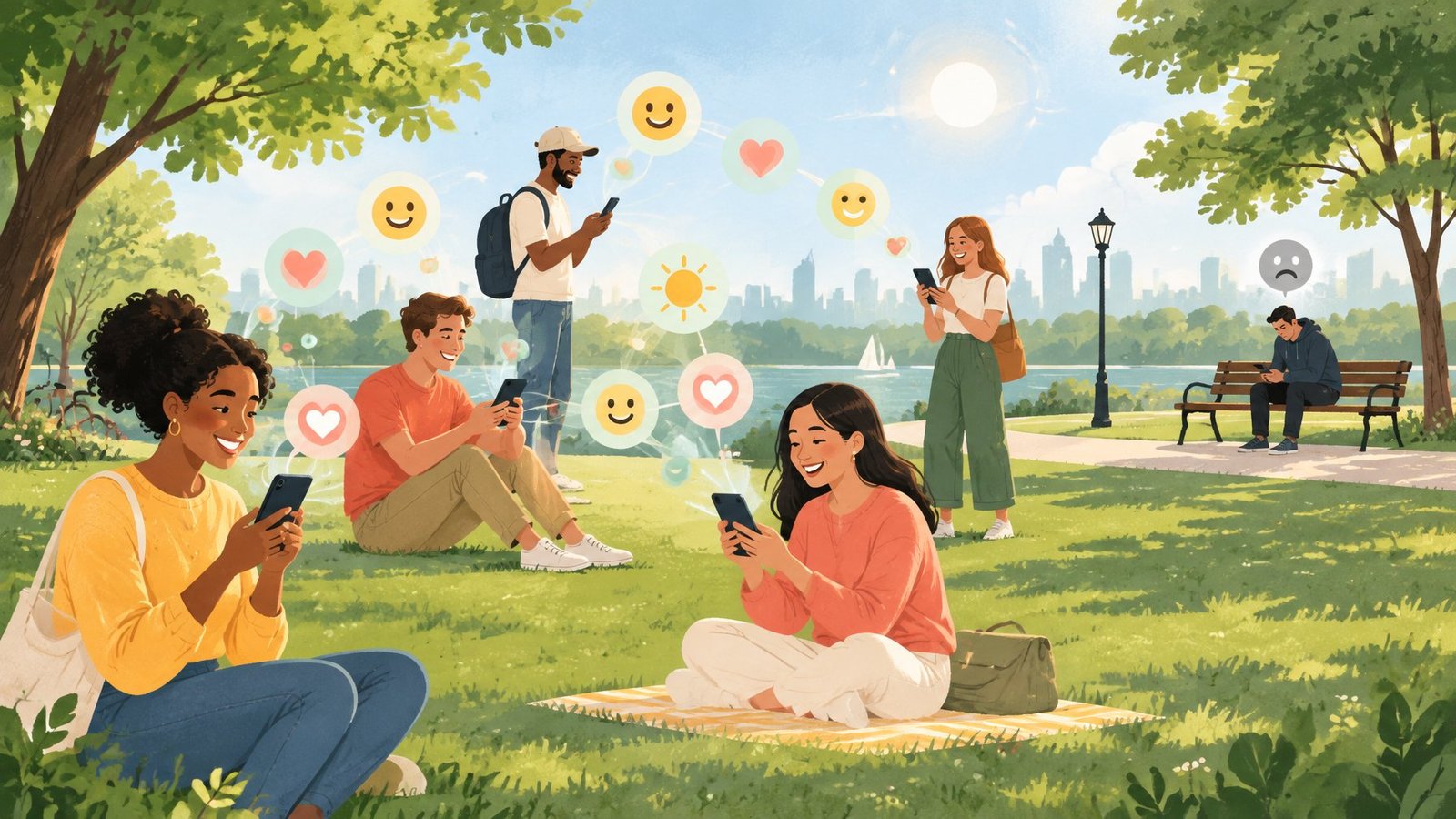
People who go out of their way to help others also tend to pepper their messages with emojis, and they lean toward the happy ones. That is the main result of a survey study linking emoji habits to personality, kindness and mental health.
The study was carried out by Janine Carroll of the Department of Psychology at the University of Chester in the UK. It was published online in Psychological Reports on December 7, 2023.
Five questionnaires and 222 emoji users
Participants were recruited between October 2020 and March 2021 through the University of Chester and the online platform Prolific. Of 565 who started, 222 were analysed, after a technical fault let people tick more than one answer on the emoji use measure and those responses had to be discarded. Most of the final sample were women, with an average age of about 23.
Everyone completed scales on anxiety and depression, prosocial behaviour, the Big Five personality traits, how often and why they use emojis, and which of 36 emojis felt “like me”. Half of those emojis expressed positive feelings and half negative ones.
Prosocial people send more, and happier, emojis
Prosocial behaviour, such as helping and sharing, was the most consistent predictor. It correlated with how often people used emojis (r = .32), with their motivation to use emojis to make messages more expressive (r = .39) and with their preference for positive emojis (r = .36).
On its own, prosocial behaviour explained 15.4% of the variation in motivation to use emojis and 10.2% of the variation in how often people used them. Adding extraversion and agreeableness raised the share of positive emoji preference explained to 22.6%.
Negative emojis told a different story. A liking for frowns and similar faces went with poorer general mental health (r = .42), measured as combined anxiety and depression symptoms. It also went with lower emotional stability (r = -.39), lower conscientiousness and lower extraversion.
Overall, participants said they used emojis fairly often and preferred positive emojis over negative ones.
Caveats in the design
This was a cross-sectional survey, so it shows associations rather than causes. The sample was young and mostly female, and a large share of responses were lost to the technical fault. The anxiety and depression items did not separate cleanly into two factors, so the author analysed them together as one general mental health score.
Earlier work had already suggested sad-face emojis can help flag depressive symptoms. This study adds that the person reaching for a string of smiling faces is, more often than not, also the one offering to help.
Study Details:
- Title: The Role of Prosocial Behaviour, Personality and General Mental Health in Predicting Emoji Use and Preference
- Authors: Janine Carroll
- Journal: Psychological Reports
- Publication Date: December 7, 2023
- DOI: 10.1177/00332941231220304