
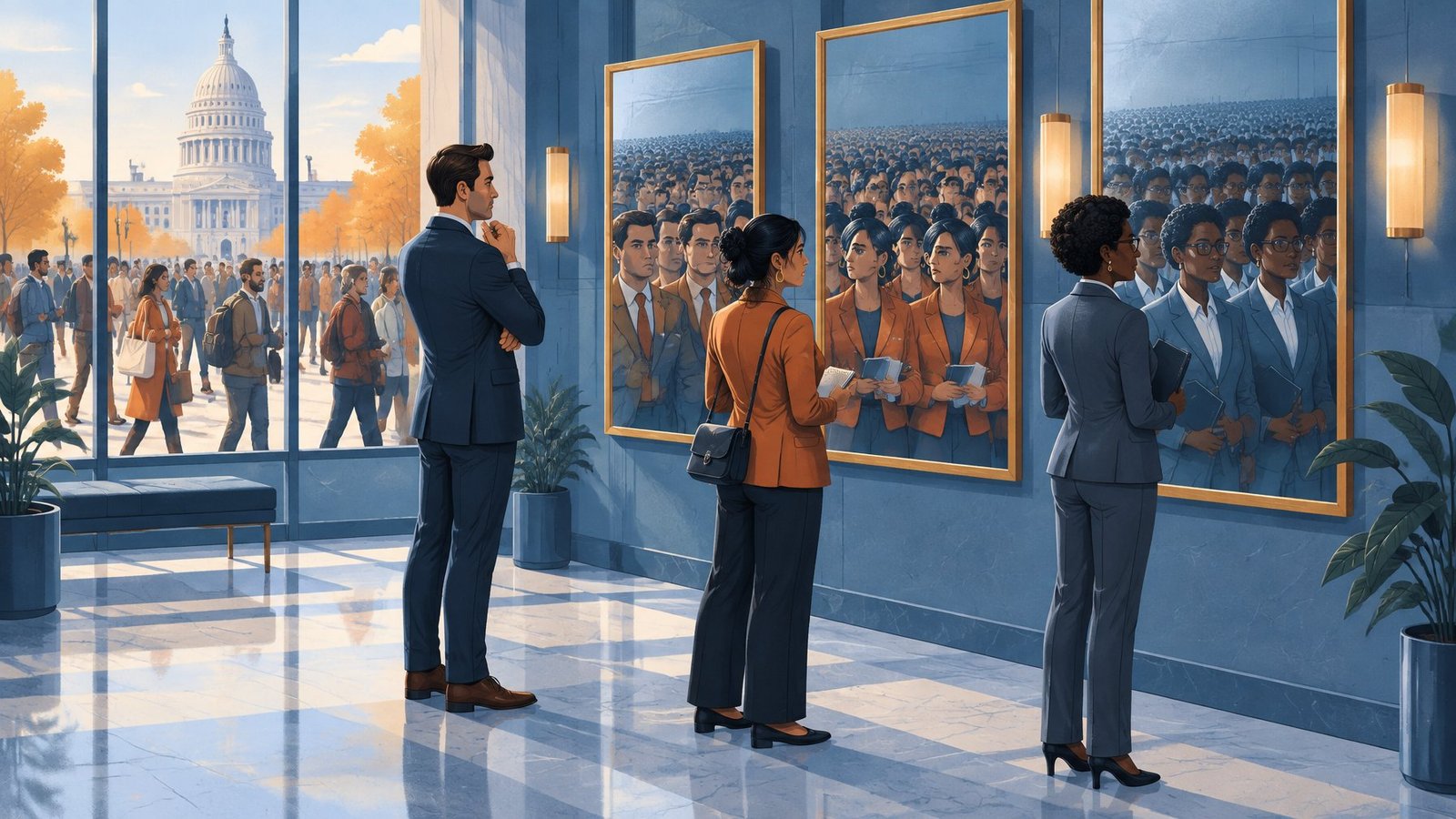
Lobbyists, civil servants, journalists and other unelected Washington insiders badly misjudge what the public thinks, and they misjudge it in the direction of their own views. Insiders who strongly support a policy think it is 10 to 12 percentage points more popular than it really is, and those who strongly oppose it think it is 10 to 12 points less popular.
The study is by Alexander Furnas of Northwestern University’s Kellogg School of Management and Timothy LaPira of James Madison University. It was published online in the American Journal of Political Science on January 30, 2024.
Surveying the people who run policy
Earlier research found that elected politicians and their senior staff tend to think voters are more conservative than they are. Furnas and LaPira wanted to know about the much larger group of influential people who never face voters.
They ran the 2020 Survey of Political Elites and Public Servants between November 19, 2020 and January 11, 2021, drawing on the Leadership Connect directory of people in government, media, law, lobbying, nonprofits and business. They got 3,743 responses, then dropped elected officials and congressional staffers who work directly for them.
In December 2020 the think tank Data for Progress surveyed 1,098 likely voters on the same ten policies, from a carbon tax and Medicare for All to a 2% wealth tax, paid family leave and increased deportations.
Each insider gave their own view on five randomly chosen policies, then later estimated what percentage of the public supports each one. Their guesses were compared with the voter survey.
Off by 14 points, in their own direction
On average, the insiders’ estimates were off by 13.7 percentage points, with a lot of spread from person to person. Unlike elected politicians, they did not lean consistently conservative.
Some examples: 37% of likely voters supported a carbon tax, but Democratic insiders put it at 48% and Republican insiders at 41%. A 2% wealth tax had 63% public support; Democratic insiders guessed 62%, close to the mark, while Republican insiders guessed 54%.
The pattern behind the errors was personal, not partisan. Comparing each insider’s answers across policies, those who strongly supported a policy overestimated its popularity by 10 to 12 points. Those who strongly opposed it underestimated it by a similar amount, with milder errors for those with milder views.
The authors call this a false consensus effect, or egocentrism: people assume others share their opinions. In their words, unelected elites believe that “the people think what I think.”
The same bias in every group
The effect held for Democrats and Republicans, for policies associated with either party, and across occupations: corporate leaders, courts, federal officials, lawyers and lobbyists, media, nonprofits and state and local government. It also held regardless of whether insiders trusted only party-aligned information sources.
The authors note that polls are an imperfect measure of what the public really thinks, and that some subgroup results were less precise. Their concern is that insiders who believe the public already agrees with them see no reason to check.
Study Details:
- Title: The people think what I think: False consensus and unelected elite misperception of public opinion
- Authors: Alexander C. Furnas, Timothy M. LaPira
- Journal: American Journal of Political Science
- Publication Date: January 30, 2024
- DOI: 10.1111/ajps.12833