
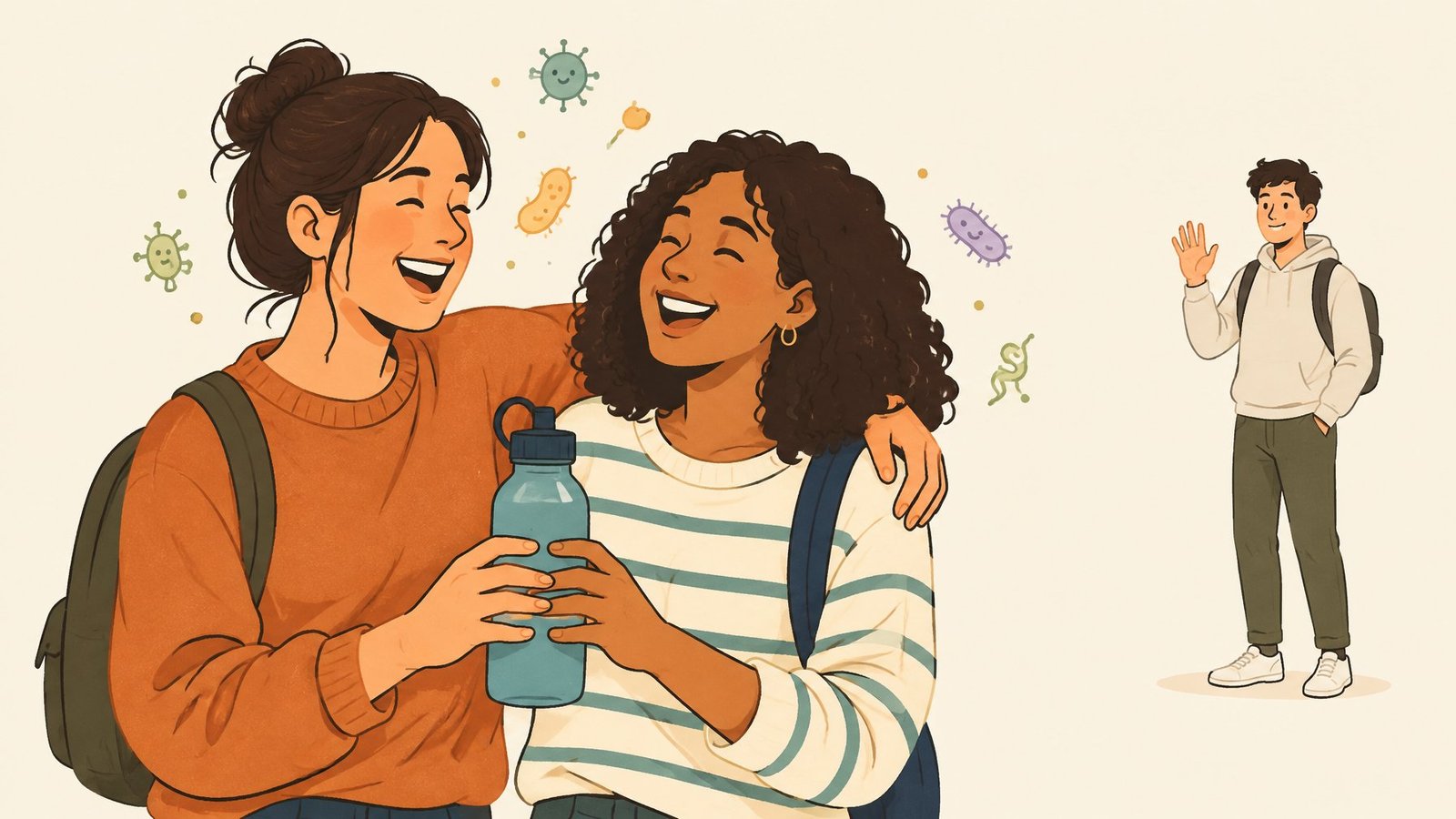
People are far more willing to risk catching germs from someone they value than from someone they do not, and that pattern held in every one of 61 societies studied. Participants were more comfortable sharing a water bottle or sitting leg to leg with a close friend than with a stranger or an enemy, and more likely to hug, kiss or shake hands with them.
The study, titled “Interpersonal value regulates infection-risky social contact across 61 societies,” was led by Hongyu Sun, Giuliana Spadaro, Sofia Pelica and Joshua M. Tybur of Vrije Universiteit Amsterdam, with 146 co-authors. It was published in the Proceedings of the National Academy of Sciences on October 15, 2026.
A trade-off as old as social life
Sharing food, exchanging objects and caring for others are central to human life, but they are also how infections spread, and many infected people show no symptoms. The researchers argue that people solve this problem by weighing the infection risk of contact against the value of the person involved.
That value is captured by what psychologists call a welfare trade-off ratio: how much weight someone gives another person’s welfare compared with their own. Earlier work in a few countries had already linked it to helping, gratitude and forgiveness, and in the United States and the Netherlands to comfort with things like sharing a towel.
Friends, acquaintances, strangers and enemies
The team collected online data from participants in 61 societies. The abstract gives the total as 47,756 people, while the paper’s study section gives 42,756.
Each participant was randomly assigned to picture one person: their closest friend, an acquaintance, a stranger, or someone they knew and disliked intensely. They then made a series of money choices between themselves and that person, which the researchers used to estimate how much they valued the person’s welfare.
Next, they rated their comfort with five everyday actions that could pass on microbes, such as standing close enough for saliva to reach their face or drinking from the same bottle. They also said whether they would touch the person when greeting them, for example with a handshake, hug or kiss.
The same pattern everywhere
In all 61 societies, the more someone valued the other person, the more comfortable they were with risky contact and the more likely they were to touch them in greeting. The average correlation was 0.43 for comfort with contact and 0.25 for greetings, and it varied little between societies.
Countries differed only slightly in how comfortable people were with contact overall: differences between societies explained about 3% of the variation. Greetings varied more, at about 7%, which the authors link to cultures having different greeting customs and signals.
Where culture made a difference
The researchers also tested ideas that disease-heavy environments or particular cultures make people avoid contact. Historical pathogen prevalence, individualism and cultural strictness had no clear general link with contact once the similarity of neighbouring societies was taken into account. Only relational mobility, how freely people can choose and replace friends, held up as a predictor of comfort with contact.
Where these factors did matter, it was mostly for close, valued partners rather than for strangers or enemies. In places with more historical disease, people were less comfortable with risky contact with friends, but not noticeably different with low-value people. That ran against the prediction that a heavy disease burden would mainly make people wary of strangers.
The authors suggest a reason: contact with people we do not value offers little benefit, so it is avoided almost everywhere, while contact with friends is worth the risk, and that is where local conditions tip the balance.
Limits
All participants had internet access and modern schooling, so the results cannot rule out that knowledge of germs, rather than an evolved tendency, shapes the pattern. The authors also note that the short money task is an imperfect measure of how much people value others, and that the relationship type itself, friend or stranger, explained some behaviour on top of it. They call for similar tests in small-scale societies.
Study Details:
- Title: Interpersonal value regulates infection-risky social contact across 61 societies
- Authors: Hongyu Sun, Giuliana Spadaro, Sofia Pelica, Joshua M. Tybur and 146 others
- Journal: Proceedings of the National Academy of Sciences (vol. 123, no. 42)
- Publication Date: October 15, 2026
- DOI: 10.1073/pnas.2615739123