
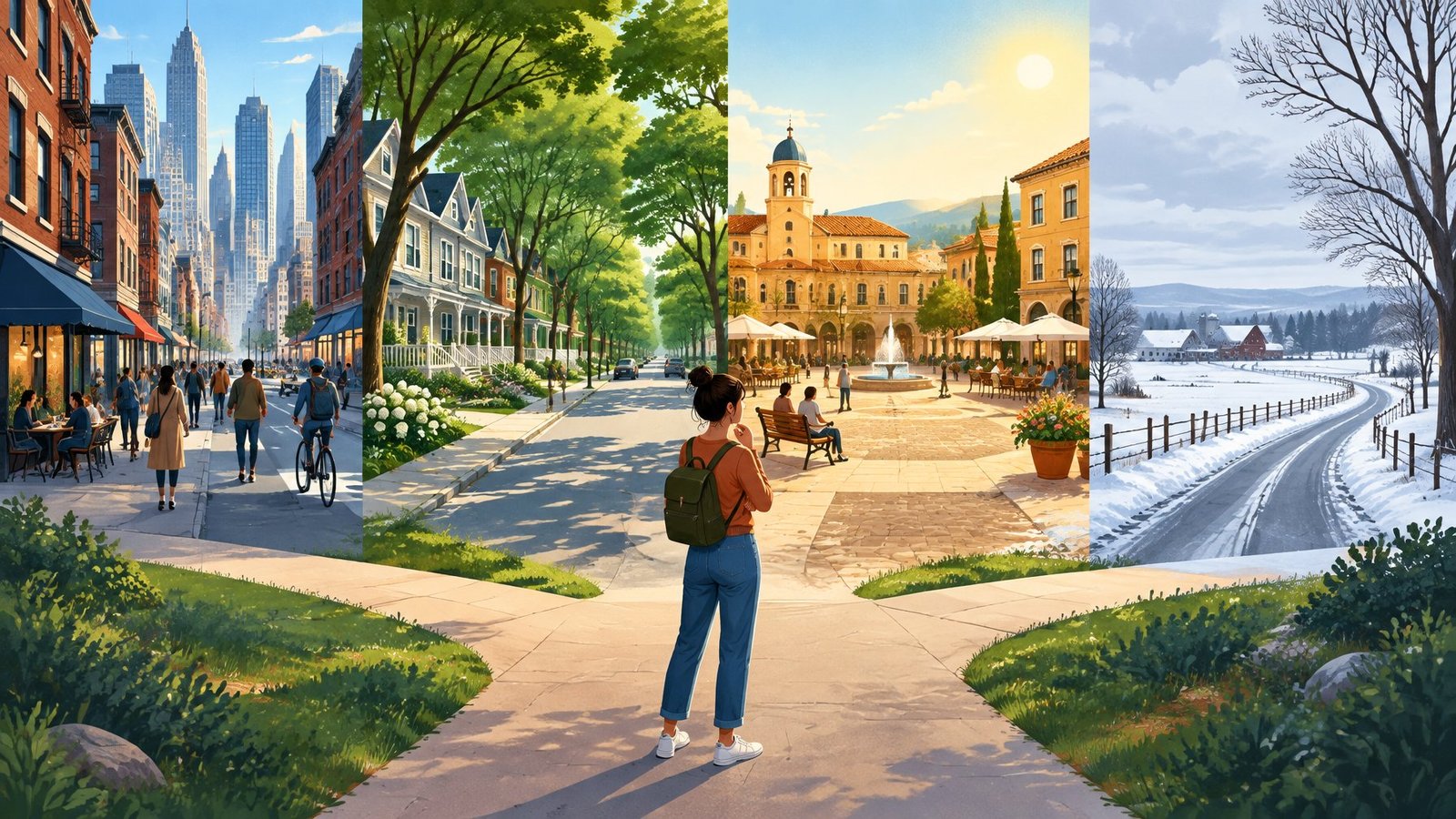
When people glance at a street, a park or a strip mall, their impressions sort into just four basic dimensions: how dense the place is, how desirable it is, how much light it has and how warm it feels. That is the conclusion of six studies proposing what the authors call the environment impressions model.
The work is by Travis Lim and Eric Hehman of McGill University. It was published online in the Journal of Personality and Social Psychology on April 13, 2026, and appears in the journal’s June 2026 issue under the title “The environment impressions model”.
From descriptions to four factors
Psychologists have long mapped how people form impressions of faces and personalities. Lim and Hehman set out to do the same for the places people live in and move through every day, drawing on 7,290 participants in total. Their supplementary materials describe a stimulus set of Google Street View images from randomly selected U.S. counties, mixing metropolitan and rural areas.
In the first study, U.S. participants described environments in their own words. In the next three, participants in the United States and the United Kingdom rated environments on the characteristics that had emerged, and exploratory factor analyses reduced those ratings to four factors: density, desirability, light and temperature.
Impressions that change behavior
The final two studies tested whether the factors matter. In the fifth, the four dimensions were associated with different behavioral intentions. In the sixth, the researchers systematically altered how environments looked and found that impressions shifted on the specific factor they had manipulated.
The authors present the model as a foundation for studying how impressions of surroundings might shape people’s attitudes and behaviors.
Study Details:
- Title: The environment impressions model
- Authors: Travis Lim, Eric Hehman
- Journal: Journal of Personality and Social Psychology
- Publication Date: April 13, 2026
- DOI: 10.1037/pspa0000485