
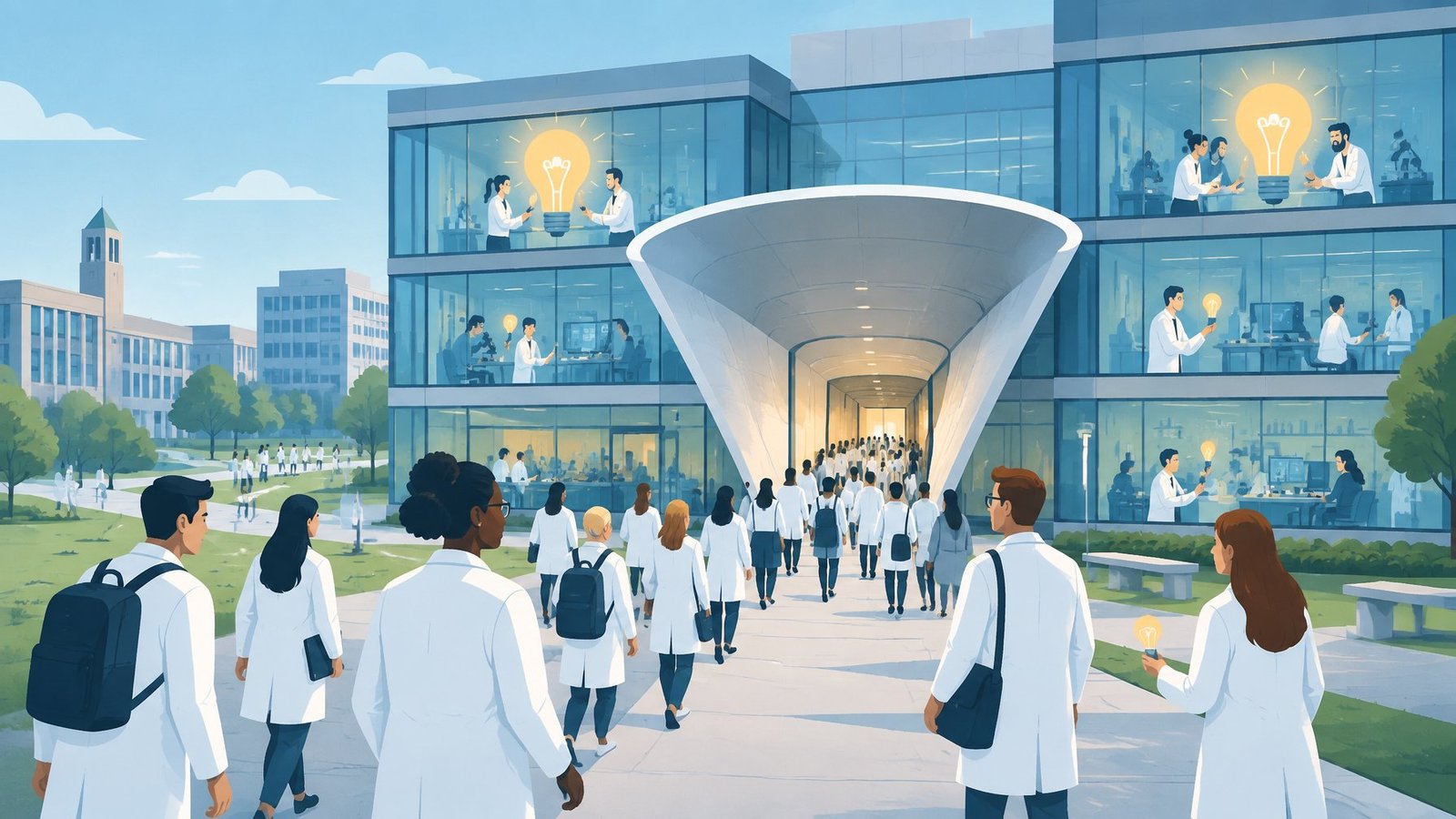
Economists have long worried that new ideas are getting harder to find, because the US pours ever more people into research without faster productivity growth. A new working paper argues that part of the slowdown has a simpler cause: as research expanded, the average researcher became less able.
The paper is by Lorenz Ekerdt of the Center for Economic Studies at the U.S. Census Bureau and Kai-Jie Wu of Penn State. It is dated November 2024 and appeared as a U.S. Census Bureau working paper.
The authors put their conclusion in one line: “not only ideas are getting harder to find; researchers are too.”
More researchers, drawn from a wider pool
Spending on intellectual property in the US has grown 23-fold since the 1930s, yet growth in total factor productivity has been flat or falling. Influential studies have read this as evidence that research suffers from steep, permanent diminishing returns.
Ekerdt and Wu point to a change in who does research. The share of the US labor force working in research has roughly tripled since the 1960s. If people sort into jobs by ability, and the best researchers tend also to be the most able overall, then expanding the field means drawing in people who are, on average, less suited to it.
They argue this is a temporary, or transitional, effect. It should fade once the share of workers in research stops rising.
Reading ability from earnings
To measure the effect, the authors used the National Survey of College Graduates, which records whether scientists and engineers actually do research and development. They defined researchers that way and tracked their earnings from 1992 to 2017, then extended the picture back to 1960 using the Decennial Census and the American Community Survey.
Two patterns stood out. The share of researchers in the overall workforce rose, but their share among college graduates fell, in step with the boom in college attendance. And earnings became more spread out among researchers and other graduates.
People who left research for other jobs earned less than researchers who stayed, which in the authors’ model means the marginal researcher is less able than the average one.
A big change for growth forecasts
Feeding these patterns into a growth model with self-selection, the authors estimate that the average ability of US researchers fell by about 49% between 1960 and 2017, a decline of roughly 0.86% a year.
Once that composition effect is separated out, the estimated permanent diminishing returns of research shrink sharply. As a result, the long-run growth rate of income per person predicted by a broad class of growth models nearly doubles, rising 1.85 times.
In a simple version of such a model, that adds about half a percentage point to long-run annual income growth.
The estimates depend on modelling assumptions, including a log-normal distribution of abilities. But the core message is that the gloomy reading of falling research productivity may be too gloomy, because a slice of the decline will end on its own once the research workforce stops growing as a share of all jobs.
Study Details:
- Title: Self-Selection and the Diminishing Returns of Research
- Authors: Lorenz K.F. Ekerdt, Kai-Jie Wu
- Journal: U.S. Census Bureau Working Paper
- Publication Date: November 2024
- Link: https://topcat.aeaweb.org/conference/2025/program/paper/KbtN272y