
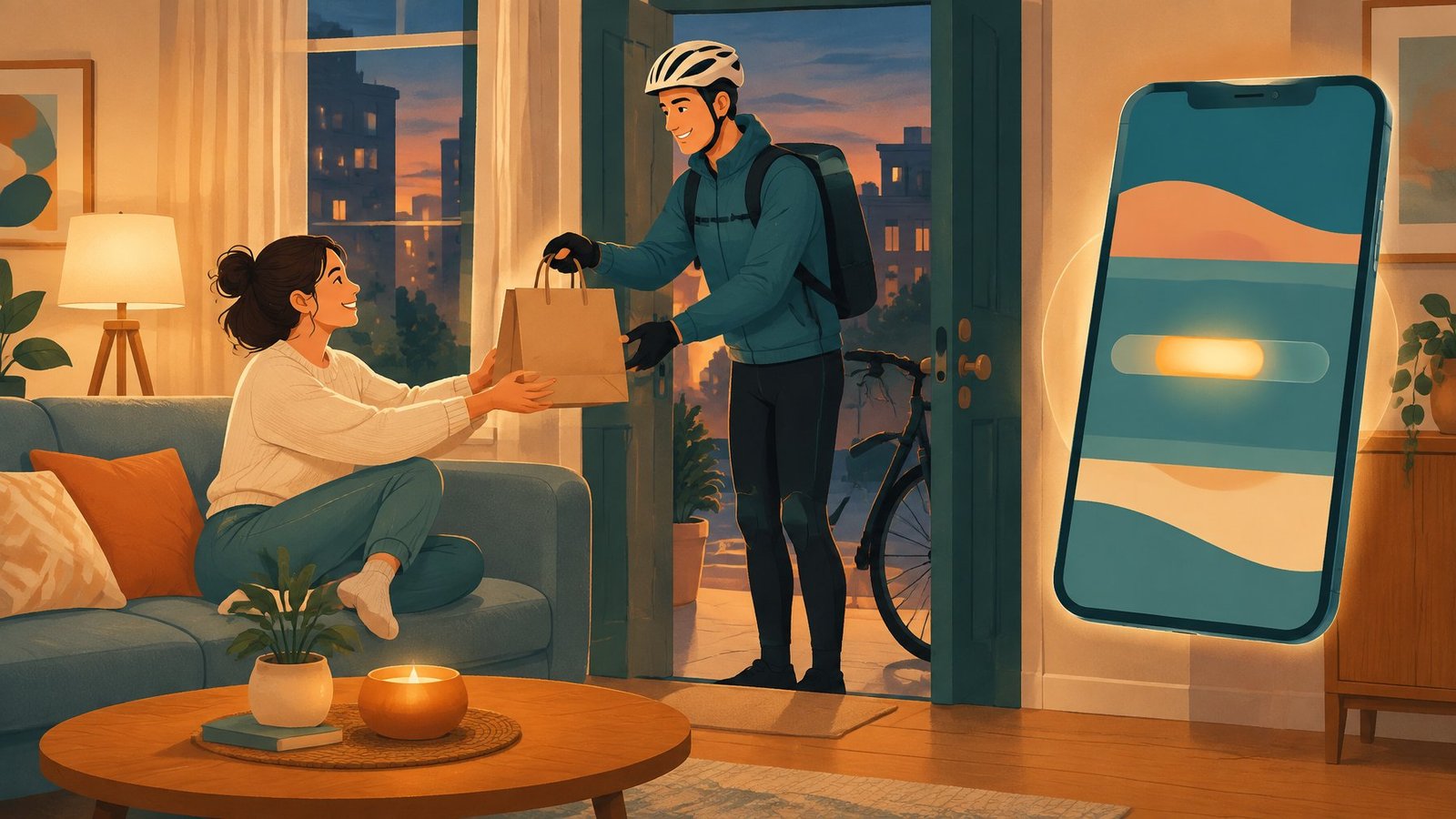
Tell a hungry customer their food will arrive in 45 minutes, and they will judge you harshly when it shows up at 52. Tell them 40 to 50 minutes, and the same app earns better reviews. Across eight experiments, people consistently preferred apps that admitted uncertainty by giving a range.
The study was carried out by Beidi Hu and Berkeley J. Dietvorst of the University of Chicago Booth School of Business and Celia Gaertig of the Haas School of Business at UC Berkeley. It was published online in Management Science on December 20, 2024.
The authors point out that real companies split on this. Some delivery apps, including Grubhub and Uber Eats, have often shown ranges, while DoorDash has often shown a single number.
Twenty orders from a fictional app
The eight preregistered experiments involved 5,323 participants in total. In most of them, people saw the estimated and actual delivery times for 20 past orders from a new food delivery app, then rated how much they liked, trusted and found the estimates useful. Actual times were drawn at random around a 45 minute average.
In the first study, with 698 people, both a moderate range (“35 to 55 minutes”) and a narrow range (“40 to 50 minutes”) beat the single estimate of 45 minutes, and the two ranges scored about the same. A third study, in which every order had a different estimate, found the same pattern: average satisfaction was 5.32 on a 7 point scale for ranges against 4.70 for point estimates.
There was a limit. An extremely wide range of 15 to 75 minutes was liked less than the moderate range, and even less than the single number.
Not just a dislike of lateness
One obvious explanation is that people simply hate late food, and a range makes lateness less likely. The researchers tested this by adding a conservative single estimate of 55 minutes, matching the top of the range. People still preferred the range, even though both produced “late” deliveries equally often.
Optimistic estimates fared worst of all. An app that promised 35 minutes was rated well below both the accurate and the conservative versions.
A mediation study pointed to expectations as the mechanism. With a range, participants judged deliveries to be unexpectedly late far less often, and once that was accounted for, the gap in satisfaction disappeared.
A choice with money on the line
In an incentivised study, participants had to budget their own time for a slider-moving task, earning a $1 bonus if they finished a page in time. After seeing how two forecasting models had performed, 70.7% chose the one that gave ranges. Those choosing the range model gave themselves more time.
A final study with 888 people moved the test to a GPS app, with short and long trips and a skewed distribution of arrival times where bad delays are possible. Ranges again won over accurate single estimates.
The practical upshot is simple: an app that shows “40 to 50 minutes” instead of “45 minutes” is likely to leave customers happier with the same real-world performance.
Study Details:
- Title: How Should Time Estimates Be Structured to Increase Customer Satisfaction?
- Authors: Beidi Hu, Celia Gaertig, Berkeley J. Dietvorst
- Journal: Management Science
- Publication Date: December 20, 2024
- DOI: 10.1287/mnsc.2023.00137