
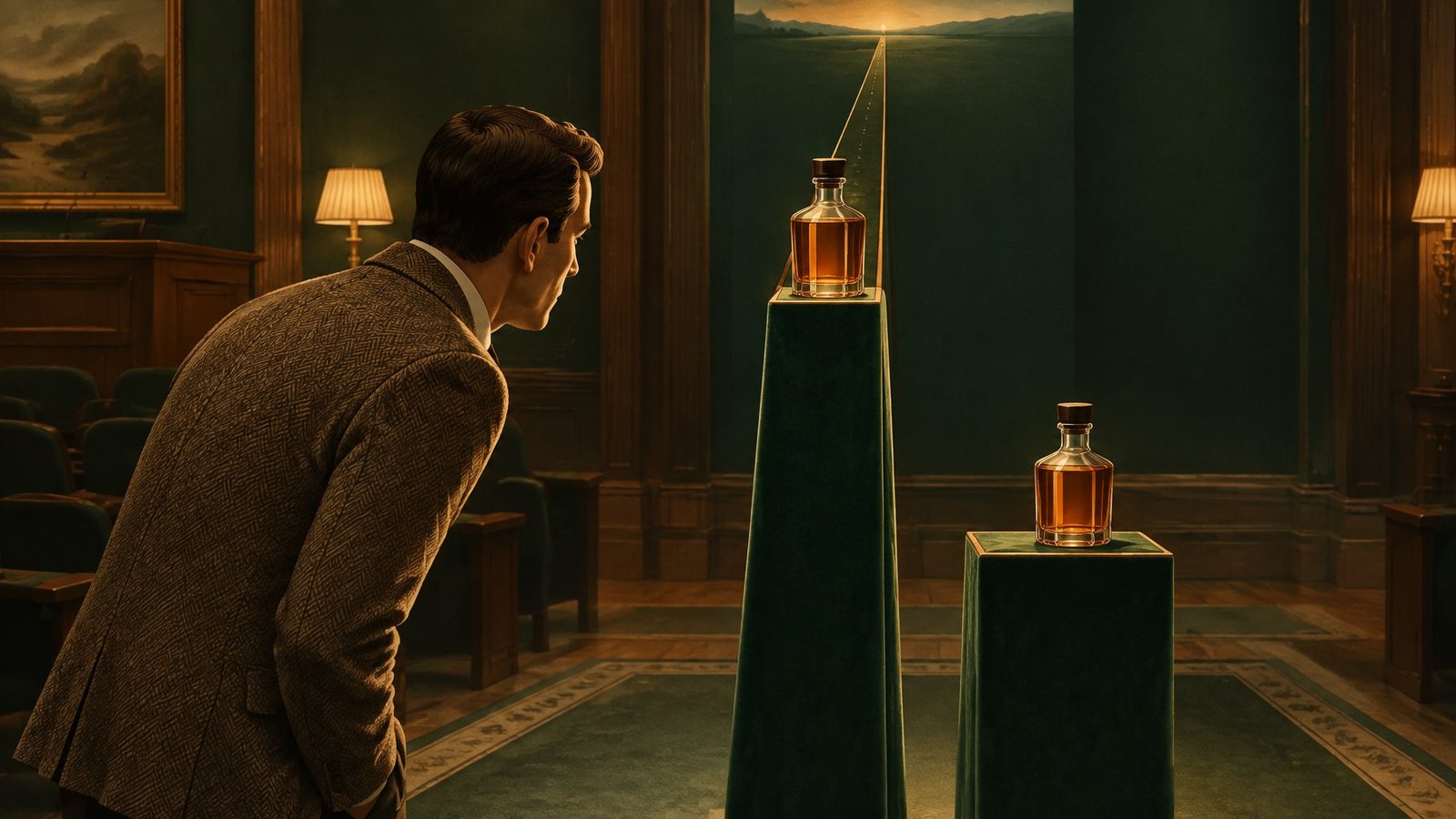
Telling shoppers a whisky is “24 years old” makes it feel older, and worth more, than telling them it was distilled in 2000 and bottled in 2024. The ages are identical. The perception is not.
That is the core finding of a study by Deepak Sirwani of the UBC Sauder School of Business, Tatiana Sokolova of Tilburg University and Suzanne Shu of Cornell University. It was published online in the Journal of Marketing Research on March 4, 2026, in the journal’s June 2026 issue.
The authors call it the year-length effect: describing a span of time as a length stretches it in the mind, while describing it with a calendar year compresses it.
Real auctions and seven experiments
The team first analysed 50,916 whisky auctions run on a UK-based online platform between March 2016 and January 2024, covering 1,385 brands. Some listings framed age by length (“30 Years Old”), others by year (“1989 The Macallan”).
After controlling for age, bottle size, alcohol strength, brand, whisky type, region, rarity wording and other factors, bottles described by length sold for 8.9% more on average. More than 30% of brands still used year framing for at least one product.
Seven preregistered experiments followed. In one, 837 Prolific participants rated how far away past and future time points felt; intervals framed as lengths felt longer. In an incentive-compatible whisky choice, people picked the older, pricier miniature 75.4% of the time when ages were shown as lengths, against 64.4% when shown as years.
When age is a drawback, the effect flips
The same stretching works against products whose value falls with age. In a study of used furniture listed on Craigslist, 512 participants were willing to pay about 17% more when an item’s age was given as a purchase year rather than as a number of years.
Time framing also changed financial choices. In a mortgage experiment with 401 participants, describing the fixed-rate period as a length raised its importance in decisions from 36.4% to 42.6%, while the weight people put on the interest rate fell from 40.3% to 34.7%.
Investment returns were also rated more favourably when framed by year. The authors give the example that “value tripled since 2022” should impress more than “value tripled in three years”.
A compressed mental number line
The authors trace the effect to the logarithmic mental number line. Small numbers like 10 sit in an expanded part of that line, while large numbers like 2015 sit in a compressed part where differences feel smaller.
Two final studies supported that account. Prompting people to think of time on a linear scale weakened the effect. And in a study of brand ages with 955 participants, length framing raised willingness to pay by 44% for young brand ages but produced a nonsignificant 8% drop for very large ones, where the numbers are no longer small.
The authors suggest wine producers, who must print vintage years, could add a shelf tag such as “Bottled in 2021: 4 years old as of 2025”. A follow-up study found that adding a length cue to year framing made the period feel longer.
Study Details:
- Title: When “Year” Feels Near: How Year Versus Length Framing Alters Time Perception and Consumer Decisions
- Authors: Deepak Sirwani, Tatiana Sokolova, Suzanne Shu
- Journal: Journal of Marketing Research
- Publication Date: March 4, 2026
- DOI: 10.1177/00222437251399115