
Large language models can write a story that feels fresh. Ask them for a hundred stories from the same opening, though, and the same plot moves keep coming back, according to a study from Microsoft Research.
Weijia Xu, Nebojsa Jojic, Sudha Rao, Chris Brockett and Bill Dolan report that stories written by GPT-4 and LLaMA-3 are built from a recurring set of plot elements, while the plots of human-written stories are almost never reproduced by the models. The paper, “Echoes in AI: Quantifying lack of plot diversity in LLM outputs”, was published online in the Proceedings of the National Academy of Sciences on August 28, 2025, in the issue dated September 2, 2025.
The policeman who always says “second left”
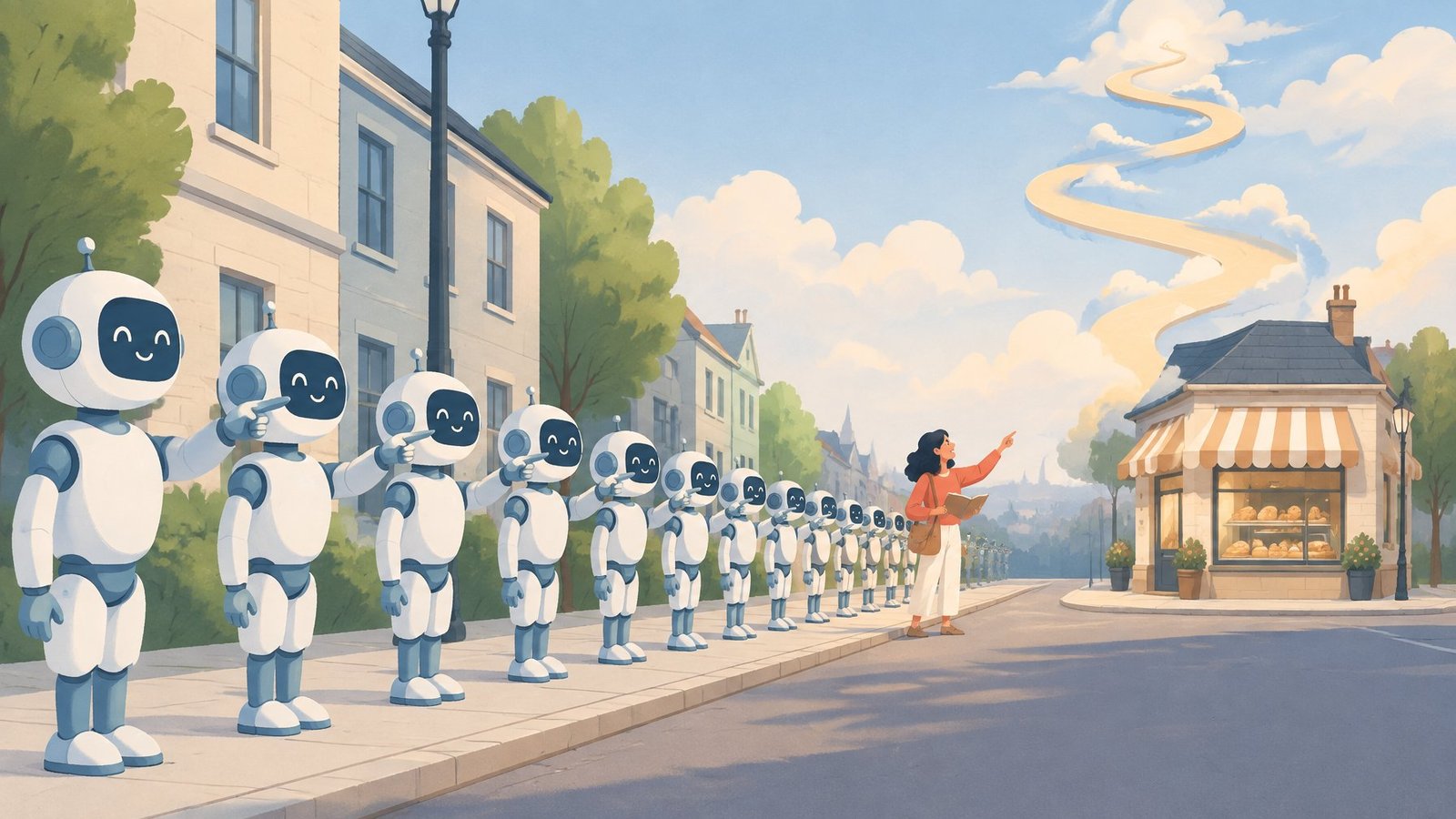
The authors open with a striking example. They gave GPT-4 the first part of Franz Kafka’s very short story “Give It Up”, in which a lost narrator asks a policeman for directions to the station, and asked for 100 continuations.
In Kafka’s version the policeman tells the narrator to give it up and turns away. None of GPT-4’s endings resembled that. In 50 of the 100 the policeman said to take the second left, in 18 he said the second right, and in 16 a bakery appeared as a landmark.
The researchers call these repetitions “echoes”. They are not just repeated words: the same narrative move can be phrased many different ways, which is why simple measures of vocabulary diversity miss them.
A score for how original a plot is
To measure the effect, the team built what they call the Sui Generis score. For each segment of a story, the model writes 20 alternative continuations from shorter and longer chunks of the story so far. GPT-4 then judges whether each continuation contains the same plot point. A segment that the model keeps reproducing, especially from very little context, gets a low score.
They tested the method on 100 stories with around 3,700 segments: 50 stories posted to the WritingPrompts forum on Reddit and 50 plot summaries of 2023 television episodes from Wikipedia. For each prompt, GPT-4 and LLaMA-3-70B also wrote their own stories.
On both datasets, human-written stories scored significantly higher than the stories the models produced. Plot points in machine stories were echoed more and more often as the model saw more of the story, while the models could only occasionally predict the opening stretch of a human story.
The echoes also crossed models. When stories written by LLaMA-3 were scored against continuations written by GPT-4, scores rose only slightly, by 0.6 points on the Wikipedia stories and 1.6 on WritingPrompts, against a gap of more than 6 points between human and LLaMA-3 stories. In the authors’ words, “the plots generated by LLMs are echoed frequently across different models.”
Rushed twists and real surprise
The score also exposed a pacing problem. Machine stories had drop ratios, a measure of how quickly originality collapses right after a peak, of 7.8 to 11.3 percent, compared with 0.4 to 3.7 percent for human stories. That fits a complaint from professional writers that machine stories rush past their twists instead of developing them.
Four human judges rated how surprising each of 159 story segments was. Their average ratings correlated with the automatic score at 0.55, which was higher than the agreement between any single judge and the other three, at 0.38 to 0.49.
The prompt mattered for everyone. Prompts that led the models to low-scoring stories also tended to produce lower-scoring human stories, with correlations of 0.48 for GPT-4 and 0.34 for LLaMA-3. The authors conclude that a better prompt lifts both, and that prompting is itself a creative act.
Their explanation for why earlier studies disagree about machine creativity is simple: a single generated story can look novel to someone who has never read the model’s other attempts, and banal to someone who has read twenty.
Study Details:
- Title: Echoes in AI: Quantifying lack of plot diversity in LLM outputs
- Authors: Weijia Xu, Nebojsa Jojic, Sudha Rao, Chris Brockett, Bill Dolan
- Journal: Proceedings of the National Academy of Sciences, Vol. 122, No. 35
- Publication Date: August 28, 2025
- DOI: 10.1073/pnas.2504966122