
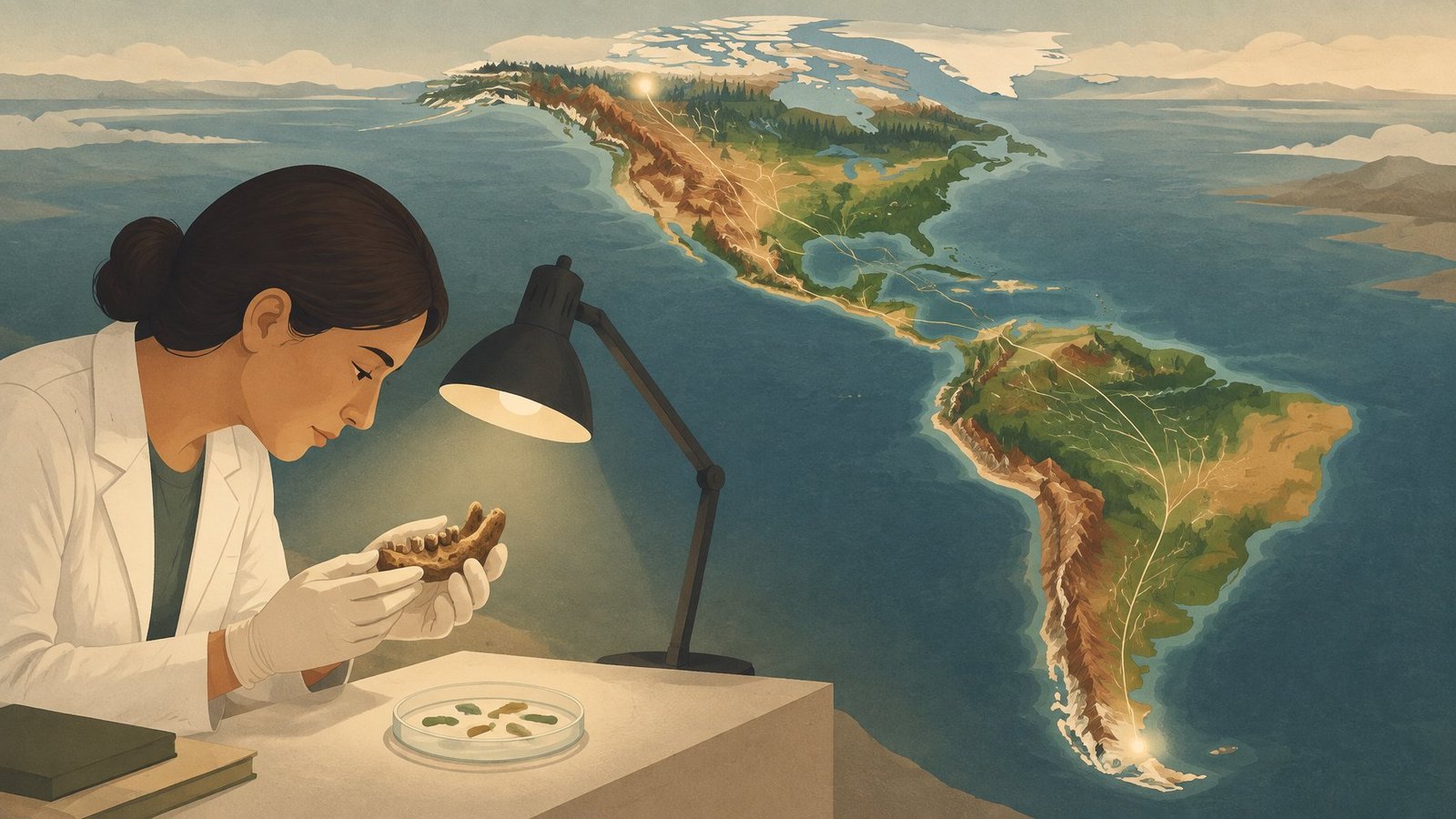
Leprosy was not only a disease Europeans brought to the Americas. A genetic study of ancient remains shows that a second leprosy bacterium, Mycobacterium lepromatosis, was already infecting people on both continents roughly a thousand years ago, centuries before European contact.
The finding overturns the long-held view that leprosy arrived only with colonization. That view still holds for Mycobacterium leprae, the most common cause of leprosy worldwide, which the authors agree came from Europe and Africa.
The work was led by Maria Lopopolo and Charlotte Avanzi with senior author Nicolás Rascovan of the Institut Pasteur in Paris, together with a large team from Colorado State University, the University of Copenhagen, the University of Illinois and hospitals and institutes across Mexico, Brazil, Paraguay, French Guiana and the United States. It appeared as a first release in Science on May 29, 2025.
Ancient Ancestors carried the bacterium
M. lepromatosis was only identified in 2008. It has been reported almost entirely in the Americas, mainly in Mexico, plus a few cases elsewhere and in red squirrels in Britain and Ireland. Before this study, genomes existed from just three human patients and seven squirrels.
The team screened 389 ancient DNA datasets from pre-contact Ancestors across the Americas. Three tested positive for M. lepromatosis and negative for M. leprae: one from what is now Canada and two from the Southern Cone of South America.
Radiocarbon dating placed them at about 1,310, 942 and 860 years before present. Their genomes showed only ancestry Indigenous to the Americas. Only the Canadian individual showed slight jaw changes consistent with early leprosy; the other two skeletons showed no visible signs, which the authors note is common because bone damage occurs in only a small share of cases.
The researchers recovered high-coverage bacterial genomes from two of them. Despite coming from opposite ends of the hemisphere, the two ancient strains sat next to each other on the family tree.
Five lineages, one dominant today
The team also screened 408 recent samples, mostly from leprosy patients in the USA, Mexico, French Guiana, Brazil and Paraguay. Thirty-four were positive, mostly from North and Central America. Only one of 360 South American samples tested positive.
They obtained genomes from 23 of these and assembled a new reference genome of about 3.26 million base pairs from a Costa Rican strain grown in mouse footpads.
Combining ancient and modern data revealed five distinct clades. Twenty-four of 26 present-day human strains belonged to one nearly clonal group the authors call the Present-Day Dominant Clade. A previously unknown basal lineage was also found infecting people in North America today, including one strain that appears to be a hypermutator but carries no known drug-resistance mutations.
Dating the family tree
Molecular clock analyses put the common ancestor of all M. lepromatosis clades at a median of about 9,400 years ago. The squirrel lineage split off around 3,200 years ago, and the ancient South American and modern dominant clades shared an ancestor about 1,500 years ago.
The dominant modern clade traces back only about 280 years, which the authors suggest could reflect the upheaval of the colonial period, though they call it a hypothesis. The squirrel strains share an ancestor about 105 years ago, consistent with a recent spillover from an American source.
The team also recalculated when M. leprae and M. lepromatosis diverged: about 720,000 years ago under their preferred model, far more recent than the 14 million years estimated in earlier work.
The authors caution that long unsampled branches mean much of the pathogen’s history is still missing, and that its near absence in South American samples may reflect gaps in sampling rather than true absence.
Study Details:
- Title: Pre-European contact leprosy in the Americas and its current persistence
- Authors: Maria Lopopolo, Charlotte Avanzi, Sebastian Duchene, Pierre Luisi, Alida de Flamingh, Gabriel Yaxal Ponce-Soto, Gaetan Tressieres, Sarah Neumeyer, Frédéric Lemoine, Elizabeth A. Nelson, Miren Iraeta-Orbegozo, Jerome S. Cybulski, Joycelynn Mitchell, Vilma T. Marks, Linda B. Adams, John Lindo, Michael DeGiorgio, Nery Ortiz, Carlos Wiens, Juri Hiebert, Alexandro Bonifaz, Griselda Montes de Oca, Vanessa Paredes-Solis, Carlos Franco-Paredes, Lucio Vera-Cabrera, José G. Pereira Brunelli, Mary Jackson, John S. Spencer, Claudio G. Salgado, Xiang-Yang Han, Camron M. Pearce, Alaine K. Warren, Patricia S. Rosa, Amanda J. de Finardi, Andréa de F. F. Belone, Cynthia Ferreira, Philip N. Suffys, Amanda N. Brum Fontes, Sidra E. G. Vasconcellos, Roxane Schaub, Pierre Couppié, Kinan Drak Alsibai, Rigoberto Hernández-Castro, Mayra Silva Miranda, Iris Estrada-Garcia, Fermin Jurado-Santacruz, Ludovic Orlando, Hannes Schroeder, Lluis Quintana-Murci, Mariano Del Papa, Ramanuj Lahiri, Ripan S. Malhi, Simon Rasmussen, Nicolás Rascovan
- Journal: Science
- Publication Date: May 29, 2025
- DOI: 10.1126/science.adu7144