
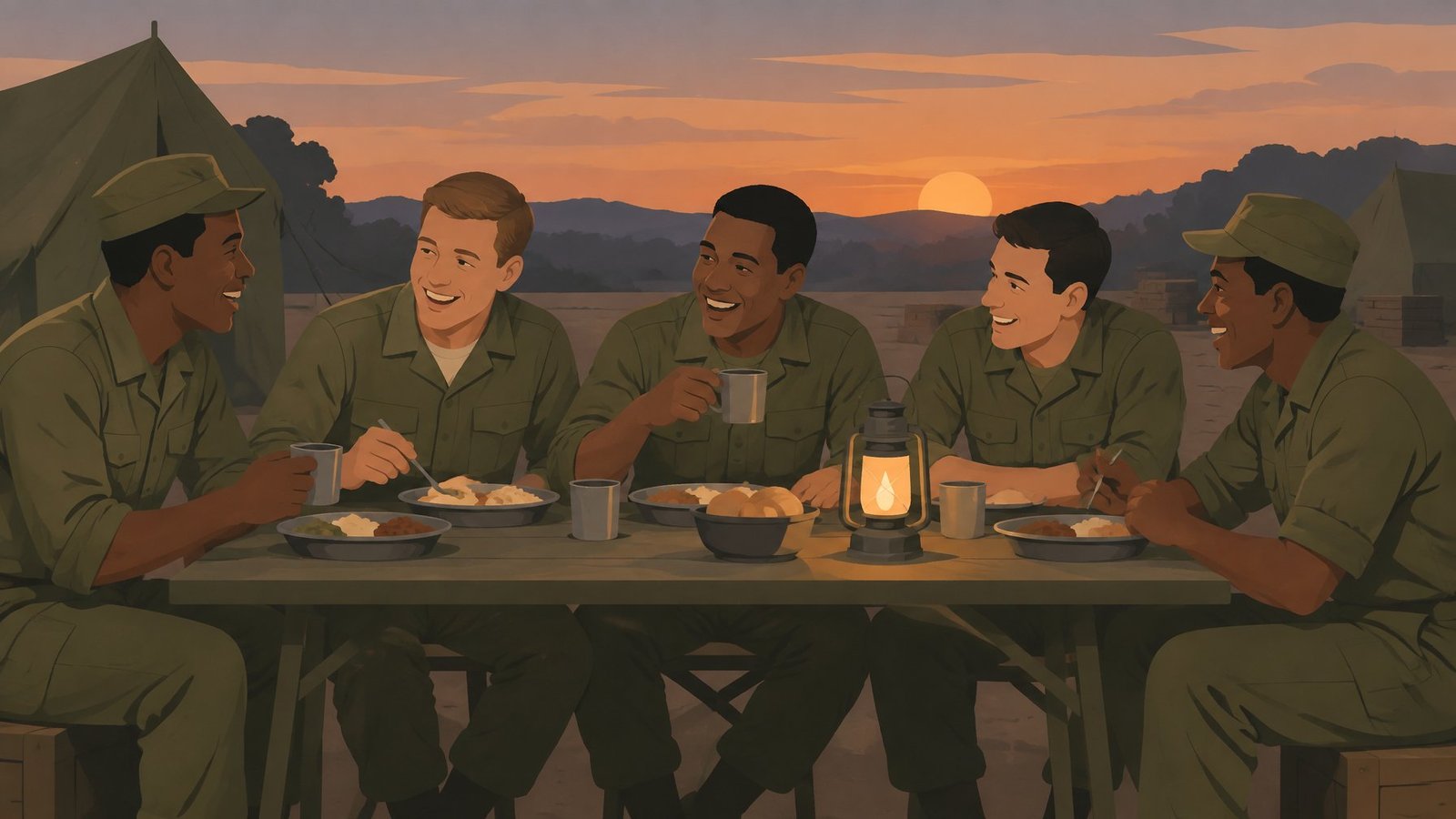
White men whose birthdays were drawn in the Vietnam draft lottery went on to hold warmer views of Black Americans for years afterward. The shift showed up only in the birth cohorts the lottery actually pushed into uniform, which points to the experience of serving alongside Black soldiers as the cause.
The study is by political scientist Donald P. Green and Oliver Hyman-Metzger of Columbia University. It was published online in the American Political Science Review on December 17, 2024, and appeared in the journal’s November 2025 issue (read the paper).
A random draw as a natural experiment
The draft lotteries picked men for service by birth date, which makes them a rare real-world experiment: whether a man was called had nothing to do with his background or beliefs. The authors worked with NORC, which runs the General Social Survey, to flag which respondents born in the lottery years had a drafted birth date, using restricted data because birth dates are not public.
The survey interviewed 3,819 men subject to the lottery between 1978 and 2021. The key group was white men born from 1950 to 1952 (1,204 in the sample), for whom a drafted number raised the chance of military service by 17.1 percentage points. For men born 1944 to 1949 the lottery barely changed who served, and men born in 1953 drew numbers but no one was called. Those groups serve as checks.
Warmer attitudes that faded with time
Being drafted moved seven of eight measures of racial attitudes in a more positive direction, and all eight measures of race-related policy views. Drafted men rated Black people’s intelligence and work ethic more favorably relative to whites, by about one-fifth of a standard deviation, and objected less to a family member bringing a Black friend home to dinner, by about a third of a standard deviation.
Across 20 race-related outcomes, the average effect was 0.07 standard deviations. The effects were largest in the late 1970s, with a modeled effect of about 0.18 standard deviations in 1978, and gradually shrank as the men aged. More than half the respondents were interviewed after 1996, roughly 25 years after the lotteries.
Party loyalty did not move. Drafted and non-drafted men looked the same on party identification, liberal-conservative self-placement and presidential vote choice. The lottery for men born in 1953, when nobody was drafted, showed no effect on racial views, which is why the authors credit military service rather than the lottery itself.
The authors’ own caution
Green and Hyman-Metzger are candid about the statistics. Their preregistered plan covered 28 outcomes, and after a strict Bonferroni correction for that many tests the race-related results no longer clear the bar. A placebo test on women, who were never in the lottery, produced a smaller and nonsignificant effect, but the authors note it as a reminder that misleading results can appear by chance.
If the pattern holds, it supports a classic idea that early researchers drew from integrated military units: sustained contact between Black and white people in a shared mission reduces hostility. The authors say the next step is to find other post-Vietnam surveys that recorded both birth dates and racial attitudes.
Study Details:
- Title: The Vietnam Draft Lottery and Whites’ Racial Attitudes: Evidence from the General Social Survey
- Authors: Donald P. Green, Oliver Hyman-Metzger
- Journal: American Political Science Review
- Publication Date: December 17, 2024
- DOI: 10.1017/S0003055424001266