
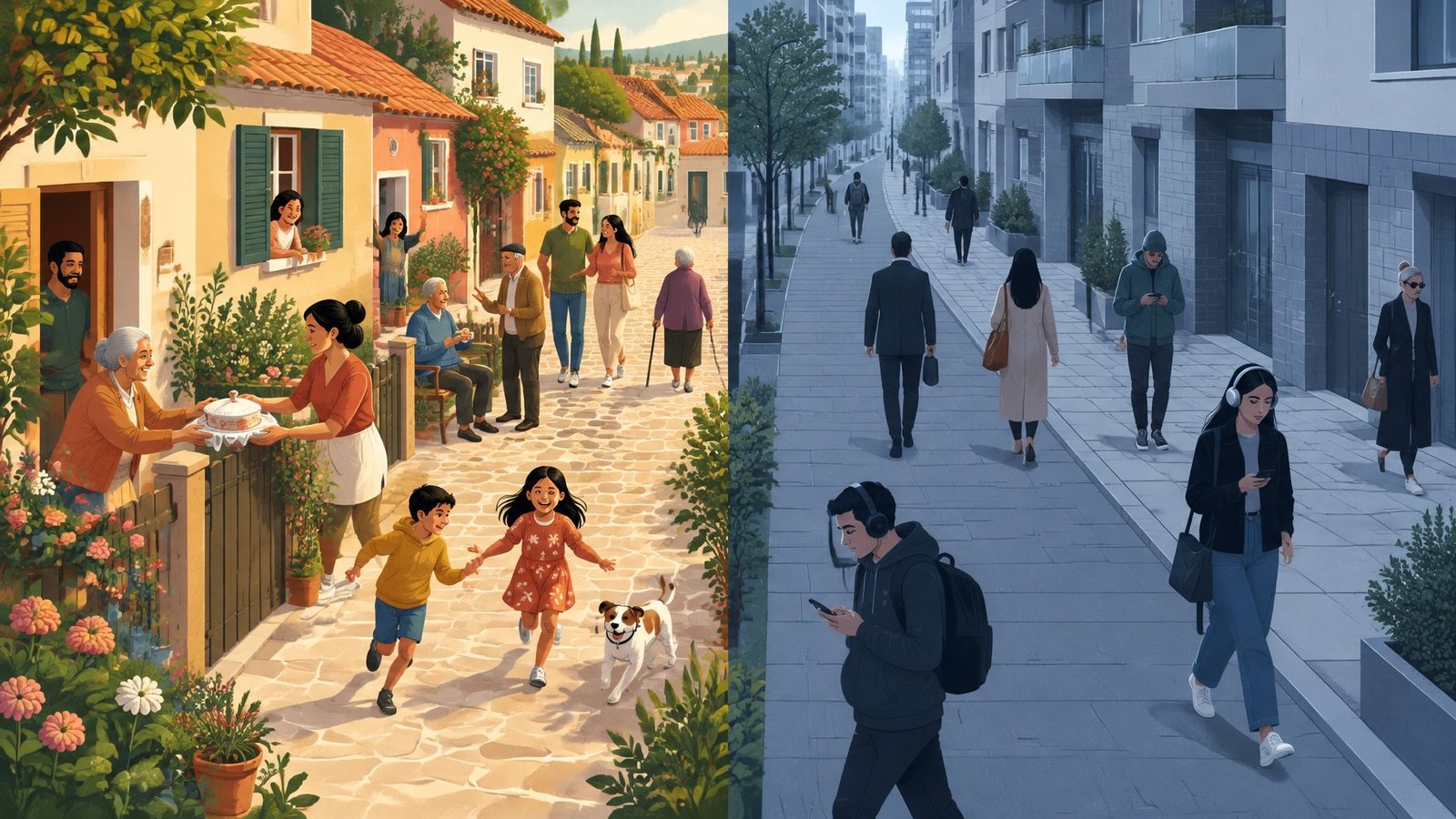
Living near lots of family changes how people think. Across six studies in three countries, people surrounded by relatives trusted their neighbours more, felt more tied to their community and were more willing to fight for their group, and some of those shifts appeared simply from imagining such a life.
The work is by Oliver Sng and Minyoung Choi of the University of California, Irvine, and Joshua M. Ackerman of the University of Michigan. It was published online in the Journal of Personality and Social Psychology on November 14, 2024.
The authors borrow an idea from behavioural ecology. Ground squirrels give risky alarm calls more when relatives are nearby, and some plants hold back root growth next to siblings. They asked whether the share of relatives in a person’s surroundings, which they call ecological relatedness, works on human psychology in a similar way.
Surveys and imagined communities
In the first study, 220 US adults rated how many relatives surrounded them now and in childhood. Those living among more relatives held more interdependent views of themselves, trusted neighbours more but not foreigners, and were more supportive of the death penalty for murder. Childhood surroundings showed no link.
The next three studies, with 371, 853 and 878 Americans, randomly asked people to imagine living in a community full of relatives or full of strangers. Imagining relatives led to a more group-centred sense of self, stronger identification with the local community, more trust in neighbours and more endorsement of statements such as being willing to fight for one’s country in a war.
Two comparison conditions tested alternatives. Imagining a town of people of one’s own race, or a town full of familiar faces, did not produce the same effects, suggesting relatives matter in their own right. People who pictured many relatives also ranked sibling incest as more morally wrong.
The death penalty was the exception: the imagination exercise never shifted those attitudes, although real-life relatedness kept predicting them.
From countries to Ghana and the Philippines
At the national level, the team used cousin marriage rates as a rough proxy for how many relatives people live among. Countries with more cousin marriage showed stronger identification with community and country, more trust in neighbours, less trust in foreigners, greater willingness to fight in a war and a higher chance of keeping the death penalty.
A final experiment ran online in the Philippines, ranked 212th of 229 countries on kinship intensity, and Ghana, ranked 30th, with 630 and 685 participants. In both, imagining a community full of relatives raised identification with community and country, trust in neighbours and readiness to fight for the group. It did not change self-concept, a measure the authors note behaved poorly in these samples.
What the authors cannot yet say
The authors list their own limits: no long-term follow-up, no behavioural measures, and no way to tell whether the kind of relative matters, such as older versus younger kin. They also note that in harsh, resource-poor settings, many relatives could mean more competition rather than more cooperation.
They suggest the idea may help explain known differences between people who move away from home and those who stay, and they predict that moving back to a hometown full of family could shift a person’s outlook back toward the group.
Study Details:
- Title: The ecology of relatedness: How living around family (or not) matters
- Authors: Oliver Sng, Minyoung Choi, Joshua M. Ackerman
- Journal: Journal of Personality and Social Psychology
- Publication Date: November 14, 2024
- DOI: 10.1037/pspa0000428