
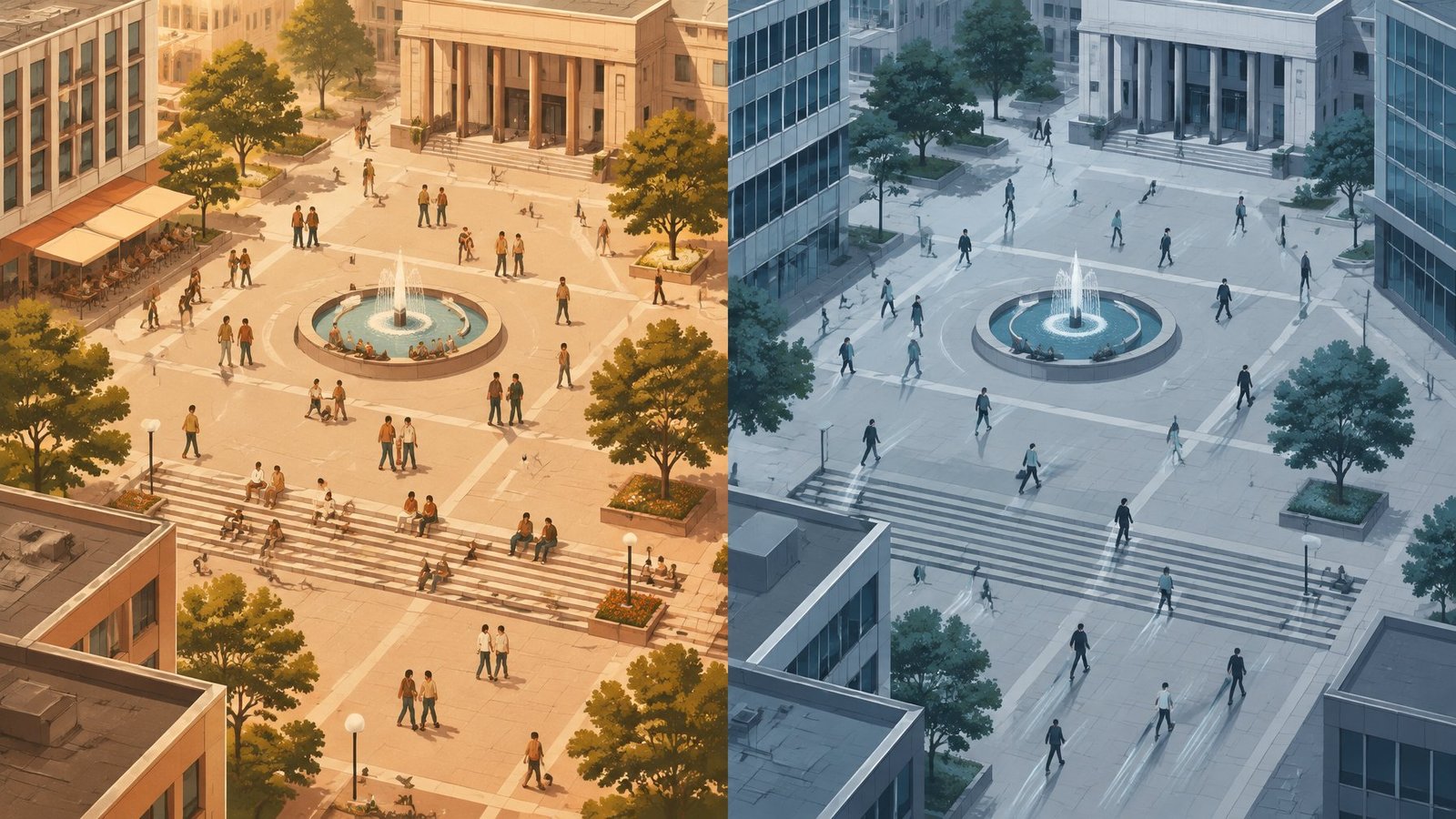
City dwellers in three American cities walked 15% faster in 2010 than they did in 1980, and far fewer of them stopped to linger or meet up with others. An AI analysis of old and new footage of the same four public spaces found that the share of people forming a group on the spot fell from about one in 20 to one in 50.
The study was released as NBER Working Paper No. 33185 in November 2024 (read the paper). Its eight authors include Arianna Salazar-Miranda of Yale University’s School of the Environment, Harvard economist Edward L. Glaeser, Keith N. Hampton of Michigan State University, and Carlo Ratti of MIT’s Senseable City Lab, with colleagues from the University of Hong Kong and MIT.
William Whyte’s films, rewatched by a computer
In the late 1970s, the urbanist William “Holly” Whyte and his students filmed street life with Super 8 cameras from rooftops and windows, then studied it by hand. Starting in 2008, Hampton digitized parts of that archive and filmed the same sites again at similar times of day.
The team analyzed 638 minutes of footage from four places: the corner of Bryant Park in New York, the steps of the Metropolitan Museum of Art, Downtown Crossing in Boston, and Chestnut Street in Philadelphia. A pedestrian-detection model, fine-tuned on hand-labeled frames from the grainy 1980 films, tracked each person’s path and speed. Anyone moving slower than 0.5 meters per second for more than five seconds counted as lingering, and two people within 1.9 meters moving together counted as a group.
Faster walking, less lingering
In 1980, 43% of people in these spaces were lingering. By 2010, that had dropped to about 26%. The drop was steepest at Downtown Crossing, where 54% lingered in 1980 and only 14% did in 2010. Single pedestrians showed the same decline, so it was not just a change in who was walking together.
Those who kept moving sped up, from an average of 1.25 meters per second to 1.41. Chestnut Street had the fastest walkers in both years, and the Met had the slowest. In 1980, 80% of people left the frame within 20 seconds of entering; by 2010, 92% did.
Walking alone barely changed: 67% of pedestrians were on their own in 1980 and 68% in 2010, with most of the rest in pairs. What did change was meeting up. The share of people who formed a new group after arriving fell from 5.5% to 2%, with big drops at the Met (12.5% to 7%) and Downtown Crossing (8% to 1%).
Thoroughfares, not gathering places
The authors read the pattern as residents treating streets more as routes than as social spaces. One possible driver they discuss is rising urban incomes, which make time more valuable. The Met is the exception: despite sitting in a high-income area, it kept high levels of lingering, which the authors take as a sign that a compelling place can still slow people down.
They note that four sites is a small sample, chosen deliberately to match Whyte’s originals, and that the changes could reflect shifts in behavior, land use or the character of each space. Their data also cannot tell whether the lost meetings were planned or spontaneous. Either way, the street corner where you once bumped into a friend now sees less than half as many of those moments.
Study Details:
- Title: Shifting Patterns of Social Interaction: Exploring the Social Life of Urban Spaces Through A.I.
- Authors: Arianna Salazar-Miranda, Zhuangyuan Fan, Michael B. Baick, Keith N. Hampton, Fabio Duarte, Becky P.Y. Loo, Edward L. Glaeser, Carlo Ratti
- Journal: NBER Working Paper No. 33185
- Publication Date: November 2024
- DOI: 10.3386/w33185