
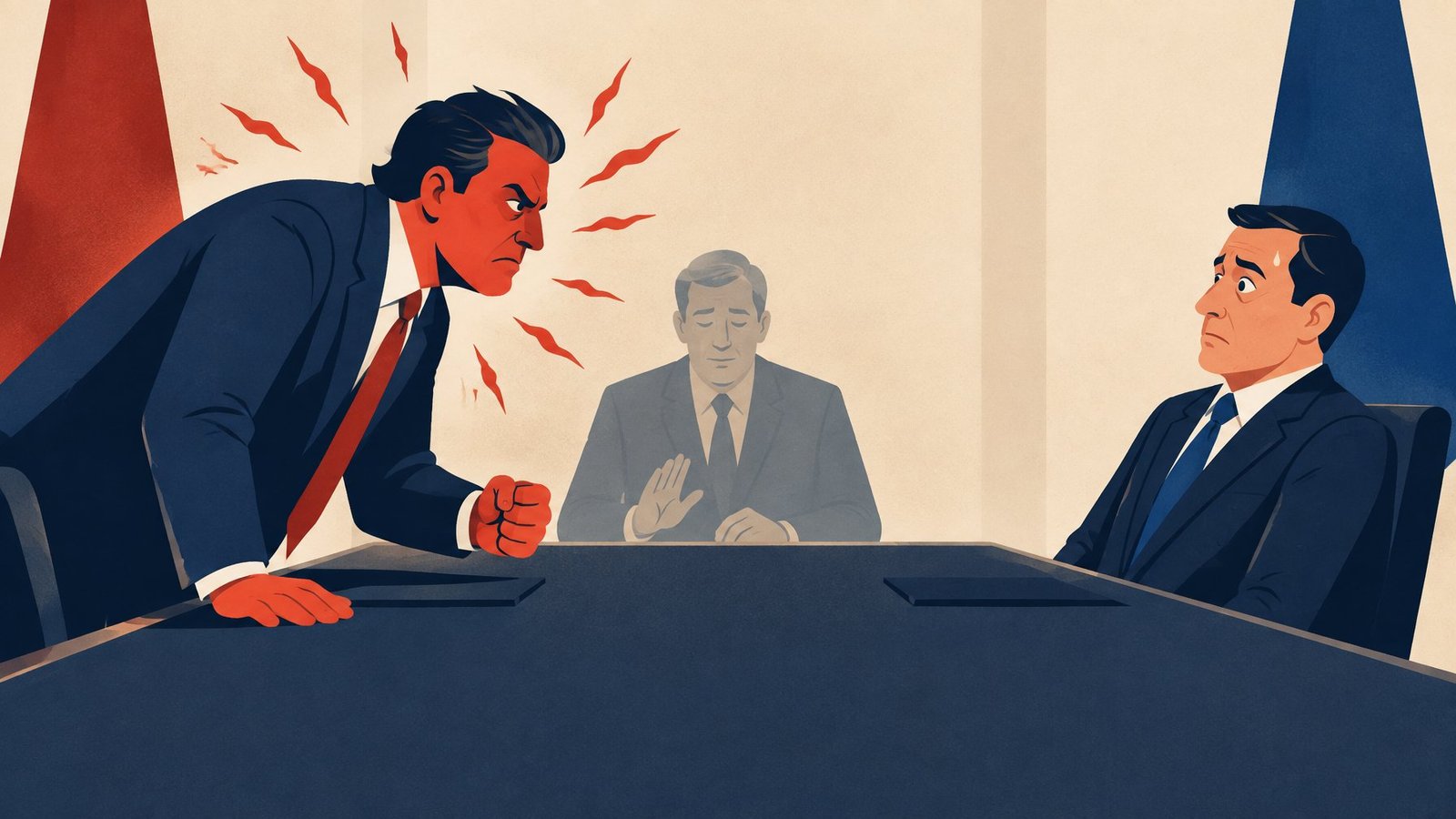
A threat delivered with visible anger is more believable than the same threat delivered calmly. A study combining half a century of crisis diplomacy with a survey experiment finds that angry leaders are seen as less sensitive to the costs of war, which makes their threats more credible, while calm threats can even backfire.
The study is by Hohyun Yoon, a postdoctoral fellow at the Christopher H. Browne Center for International Politics at the University of Pennsylvania. It was published online in the American Journal of Political Science on November 23, 2024.
Yoon starts from a puzzle. Theories based on costly signals predict that democracies should make more credible threats, yet between 1918 and 2001 compellent threats from the United States, Britain and France succeeded only 36% of the time combined, against 58% for the Soviet Union.
Fifty years of crisis statements
For the first study, Yoon built a new dataset of 5,807 public statements by world leaders during international crises from 1946 to 1996, drawn from the Foreign Broadcast Information Service and the Public Papers of the US Presidents. Each statement was hand coded for anger and for threats of force, and linked to crisis outcomes from the International Crisis Behavior project.
Threats accompanied by more anger were more likely to end in a win for the leader making them. A one standard deviation increase in anger was linked to about a 0.83 percentage point rise in a threat’s chance of success. That effect is small, Yoon notes, but it comes from words alone.
The more striking result was what happened at low anger levels. Threats only had a measurable effect once a substantial amount of anger accompanied them, suggesting that public threats may fail to convey resolve unless leaders also sound angry.
An experiment with a Russian leader
The second study was a preregistered survey experiment with 1,012 US citizens in May 2023. Respondents read a crisis scenario in which a Russian leader threatens force. In one version, he “yells in outrage” and says Russia is angered by how America treated it; in the other, he issues the same threat “in a calm, measured voice.”
With the calm leader, respondents put the chance that Russia would use force at 50.6%, essentially a coin flip. Adding anger raised that estimate by 14.6 percentage points. Respondents also became about 7.3 points more certain of their estimates, and fewer believed the leader would accept zero military casualties: 27.0%, down from 32.8%.
Comparing answers before and after the threat showed the backfire. The angry threat pushed estimates of an attack from 53.1% to 65.2%, while the calm threat lowered perceived resolve by 3.2 points.
Limits of the evidence
Yoon’s data cover only the dominant leader in each country and only public statements, not private diplomacy. He also cautions that modern media may change the picture: leaders now have more chances to show emotion, but constant exposure to angry rhetoric could make audiences treat it as cheap talk.
He suggests the same logic could extend beyond military standoffs, for example to trade disputes, where an angry leader may signal a greater willingness to absorb economic costs.
Study Details:
- Title: Anger expressions and coercive credibility in international crises
- Authors: Hohyun Yoon
- Journal: American Journal of Political Science
- Publication Date: November 23, 2024
- DOI: 10.1111/ajps.12937