
The 1979 accident at Three Mile Island did not just scare Americans away from nuclear power. A new working paper argues it froze the industry and its science for decades, at a cost measured in millions of lives lost to air pollution.
The paper is by Roma Poberejsky and Guillaume Gex of Northwestern University. It is dated August 5, 2024, and was posted on SSRN on October 8, 2024.
The authors frame it as a carefully built “what if”: what would the US power grid look like if the accident had been handled better, or had not happened at all?
A promise that stalled
In the 1970s, the Nixon administration’s Project Independence called for 1,000 nuclear plants by the year 2000. Then came the accident at Three Mile Island. The authors argue the regulatory response had two effects: a de facto halt to new plant construction, and a collapse of research on getting energy from nuclear sources, since there was no longer a market for it.
To measure the damage, they used a synthetic control method. It compares the US with a weighted blend of other countries that did not experience the accident, matched on their nuclear trajectories before 1979.
Missing reactors, missing patents
By that comparison, the US fell well behind its peers and could have had about 200 more reactors today.
The same approach applied to patents found that the branch of nuclear physics dealing with obtaining energy from radioactive sources is missing about 3 billion dollars in value compared with where it would otherwise be.
The authors then link accumulated scientific knowledge to the capacity of reactors. They find a strong connection between advances in this field and how powerful new reactors are. Without the accident, their results suggest reactors would have been about three times more powerful.
A cleaner grid that never was
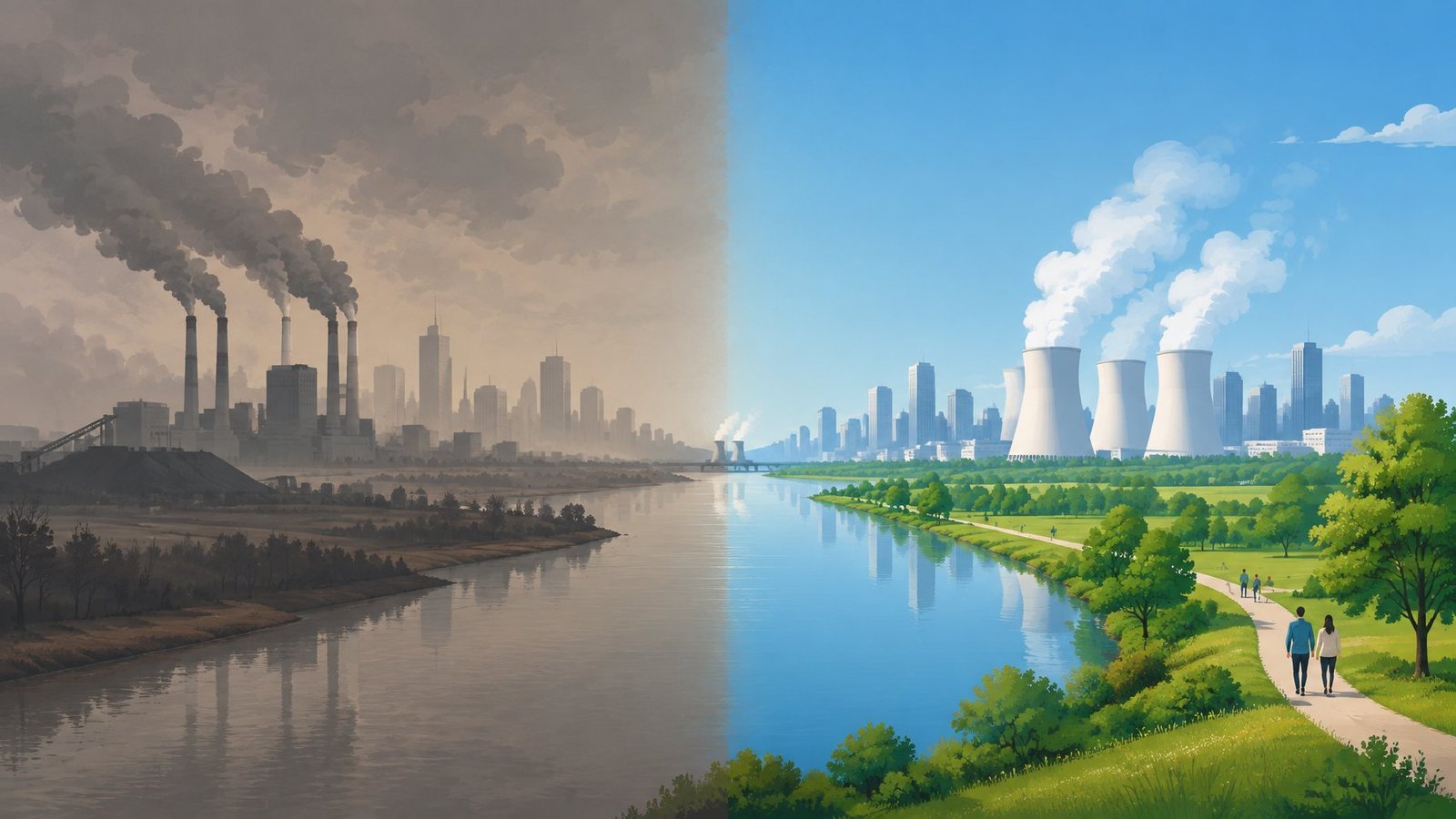
Putting these pieces together, the counterfactual US grid would have been nearly five times larger in total generation capacity. Holding demand constant, about 94% of electricity would have come from nuclear power, compared with the actual 18%.
In that scenario, coal would have been phased out entirely by 2002 and natural gas by 2010.
The authors estimate this would have avoided about 55 billion tons of carbon emissions between 1979 and 2020 and around 2.3 million premature deaths from air pollution. Health costs avoided would have been between 8 and 14 trillion dollars, counting deaths as well as emergency room visits, asthma attacks, and lost work and school days.
These figures rest on a chain of modelling steps, from reactor counts to patents to capacity to the energy mix, and each step is an extrapolation. The authors present it as a plausible scenario that does not assume unrealistic cuts in construction costs.
Their broader point is that nuclear power has been largely overlooked, or treated as part of the problem, in research on the energy transition. By their count, the price of one accident in 1979 is still visible in the air Americans breathe.
Study Details:
- Title: The Effect of TMI on the Electric Grid or: How We Did Not Learn to Stop Worrying and Love Nuclear Power
- Authors: Roma Poberejsky, Guillaume Gex
- Journal: Northwestern University Working Paper (SSRN)
- Publication Date: August 5, 2024
- DOI: 10.2139/ssrn.4944793