
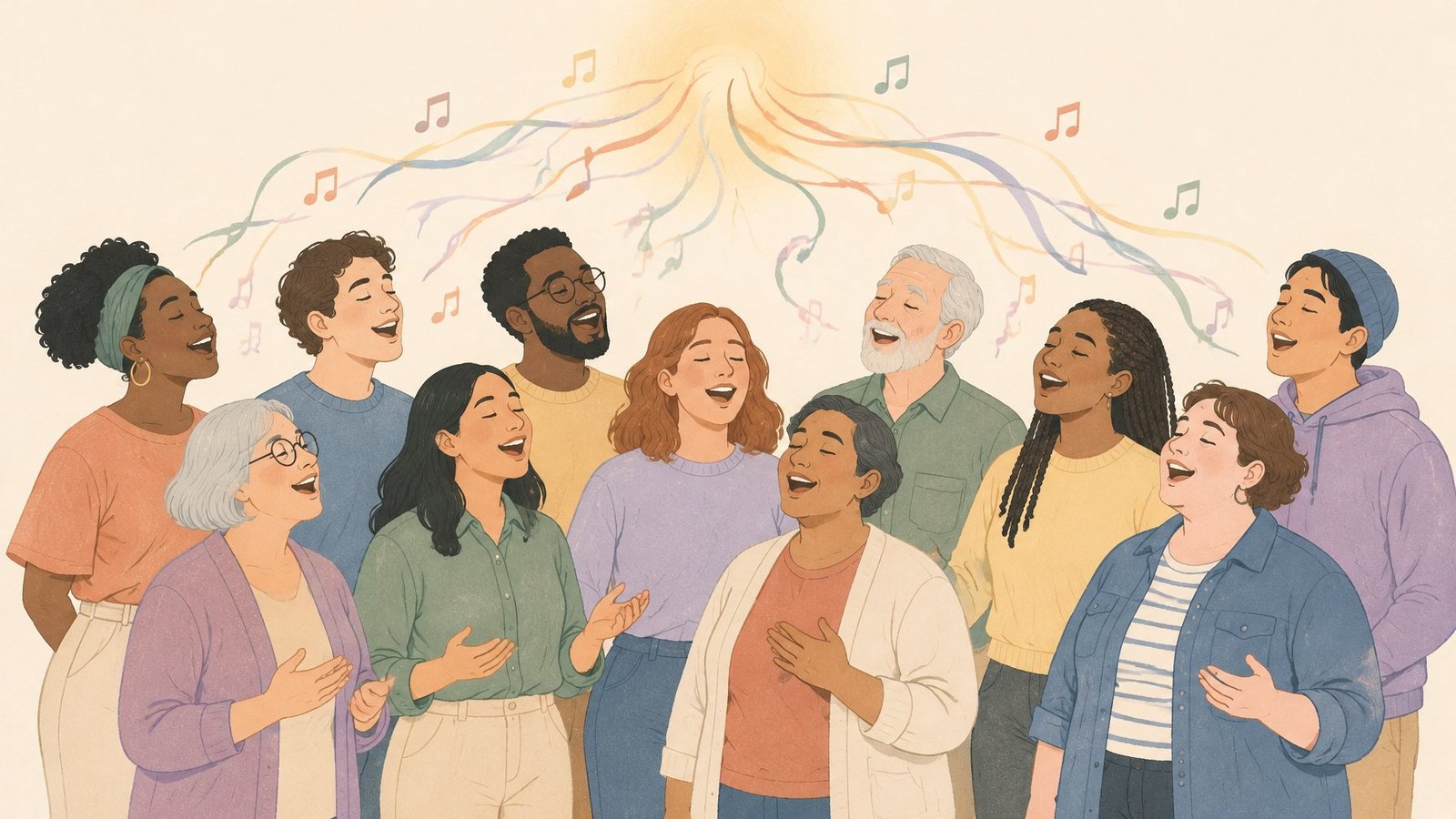
Singing with other people lifts mood and life satisfaction even when the singers are strangers, and the main reason appears to be a shared feeling that something special is happening. That feeling, which researchers call collective effervescence, also predicted benefits that lasted weeks or months after the event.
The study, titled “More Than a Song: Collective Singing Increases Well-being and Self-Expansion Via Collective Effervescence,” was written by Shira Gabriel, Nicole Koefler, Michael J. Poulin, Veronica Schneider, Maayan Dvir, Czarina Gutierrez and Esha Naidu, of the University at Buffalo, The Academic College of Tel Aviv-Yaffo and Duke University. It was published online in Personality and Social Psychology Bulletin on August 31, 2026.
Separating the singing from the group
People have sung together across history and cultures, and earlier studies have linked group singing to better well-being. Most of that work looked at choirs and other established groups, though, so it was hard to tell whether the benefit came from the singing itself or from belonging to a group that already existed.
Gabriel and colleagues tested whether singing in a group helps even without an established collective. They also looked at the mechanism. Their candidate was collective effervescence, a term from the sociologist Émile Durkheim, described in the paper as an intertwining sense that one is connected to others and that something special is happening.
Two experiments and a follow-up
The team ran two experiments and a longitudinal study. Across them, singing in groups predicted a range of positive outcomes: a better mood, greater satisfaction with life, change in how people saw themselves, which the authors call self-expansion, and a greater willingness to donate.
The analyses pointed to collective effervescence as the main route for these benefits, rather than the singing alone.
The longitudinal study suggested the effect does not fade the moment the music stops. The positive effects of the effervescence felt during a singing event could still be seen weeks and even months later.
Why it matters
The findings suggest that the value of a sing-along or a one-off community choir may not depend on knowing the people around you. What seems to count is the shared experience in the moment.
The abstract does not report sample sizes, the exact settings of the singing events or effect sizes, so how large the benefits were cannot be judged from it.
Study Details:
- Title: More Than a Song: Collective Singing Increases Well-being and Self-Expansion Via Collective Effervescence
- Authors: Shira Gabriel, Nicole Koefler, Michael J. Poulin, Veronica Schneider, Maayan Dvir, Czarina Gutierrez, Esha Naidu
- Journal: Personality and Social Psychology Bulletin
- Publication Date: August 31, 2026 (online)
- DOI: 10.1177/01461672261479483