
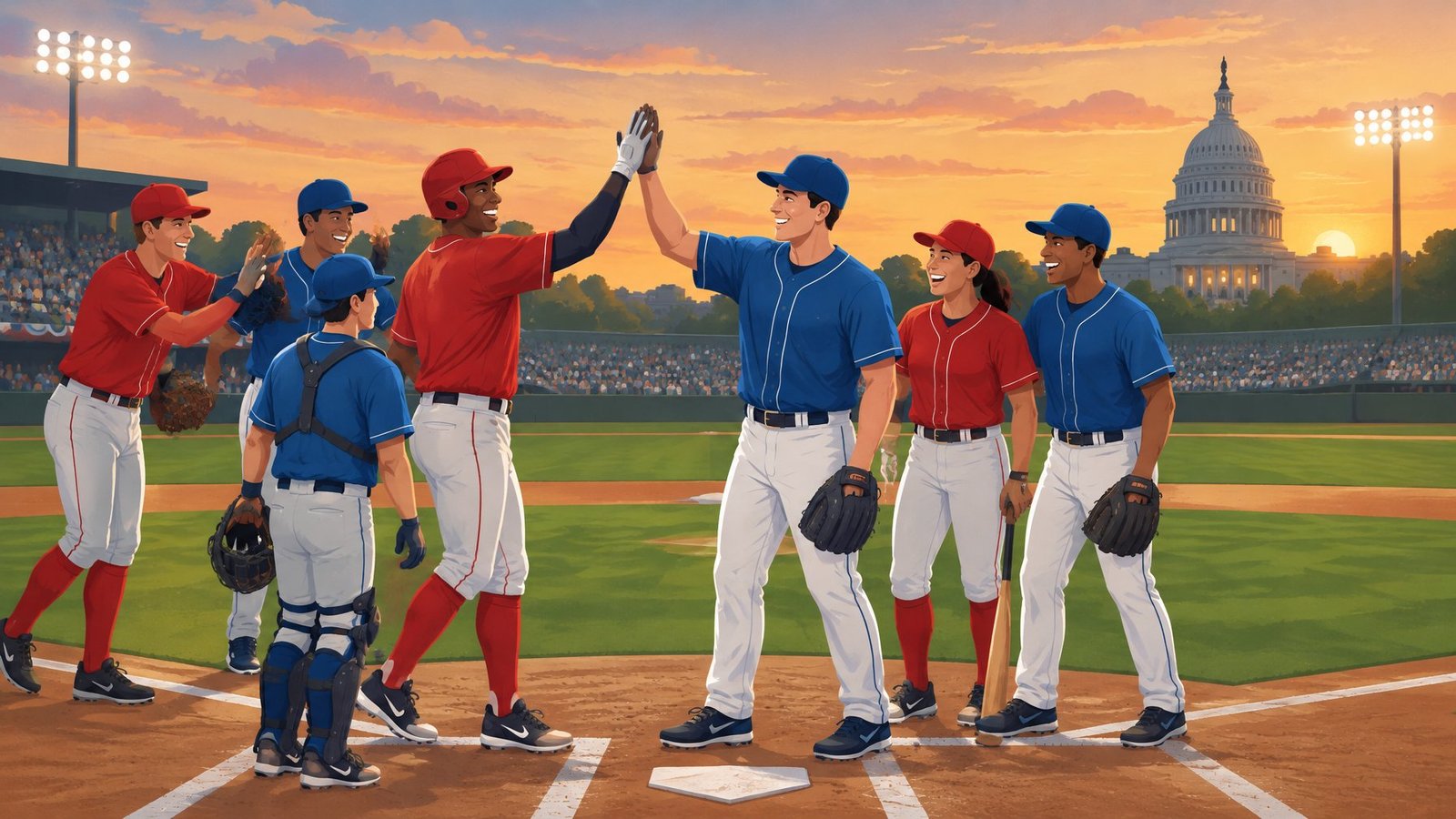
Playing baseball together may do more for cooperation in Congress than many other social ties. Lawmakers who play on the Congressional Baseball Team are more likely to work together on bills, both within their own party and across party lines.
The research note is by SoRelle Wyckoff Gaynor of the University of Virginia and Riley Millburne of the College of the Holy Cross. It was published online in American Politics Research on September 20, 2025.
Rosters meet cosponsorship networks
Members of Congress, commentators and scholars often say personal relationships matter for making policy. The authors note that in an era of leader-led lawmaking, rank-and-file members have few chances to build such relationships, particularly with the other party, which also makes those ties hard to study.
The Annual Congressional Baseball Game offers one. The authors built a new dataset of team rosters from the 114th through the 117th Congress and combined it with a network analysis of bill cosponsorship among all members.
Teammates become collaborators
Membership on the baseball team increased the likelihood of collaboration with colleagues in the same party and with members of the other party. According to the authors, the effect was larger than for other common areas of social connection between lawmakers.
The paper describes this as a seemingly simple but effective source of congressional collaboration, and adds roster data to the tools for studying social connections on Capitol Hill.
Study Details:
- Title: Playing Ball: Collaboration in the U.S. Congress
- Authors: SoRelle Wyckoff Gaynor, Riley Millburne
- Journal: American Politics Research
- Publication Date: September 20, 2025
- DOI: 10.1177/1532673X251382546