
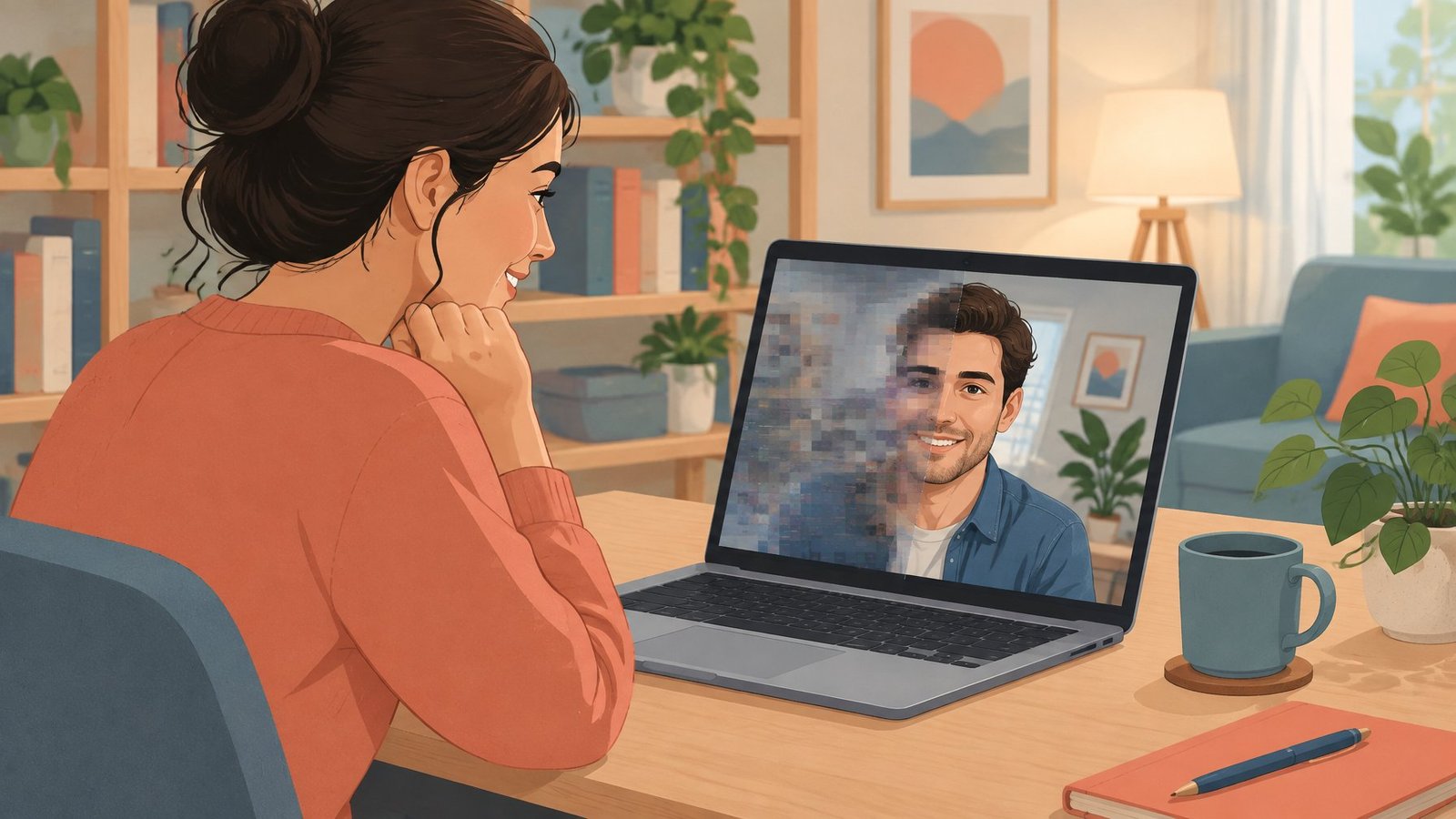
Meeting someone on a video call may feel like a thin substitute for a handshake, but it does not seem to make us worse judges of character. In two large studies, strangers who chatted over Zoom read each other’s personalities about as well as strangers who met face to face. The catch was the connection: when the picture and sound were worse, impressions became less accurate, less positive and less warm.
The research was led by Marie-Catherine Mignault, with Hasagani Tissera, Jamie Cecere, Zoe Fargnoli-Brown and Lauren Human, and was supported by the Social Sciences and Humanities Research Council of Canada. It appeared online in Personality and Social Psychology Bulletin on July 30, 2024 (read the paper).
Thousands of two-minute chats
The team ran two “round-robin” getting-acquainted studies on Zoom. In each session, groups of up to nine undergraduates met one another in a series of short one-on-one breakout rooms, each conversation lasting about two minutes, and rated every partner’s personality after each chat. The first, exploratory study ran from September 2020 to May 2021 with 567 students. A preregistered replication ran from September 2021 to August 2022 with 371 students. Together they produced roughly 5,000 analysed conversations between people who had never met.
To have a yardstick, the researchers compared these with an in-person study of 306 students using the same design, run between September 2019 and March 2020, just before the pandemic shut it down. Each participant’s “real” personality was estimated from their own ratings combined with reports from up to three close others, such as friends or parents.
Two things were measured. Accuracy meant seeing a person’s distinctive traits, the ways they differ from everyone else. Normativity meant seeing them in line with the average, socially desirable personality, which tends to come with a positive view.
Same accuracy, different clues
On both measures, Zoom matched the lab. People were as accurate and as normative online as in person, and on Zoom those who were seen more accurately and normatively were also liked more.
The details differed. Traits that are usually easy to spot in a first meeting, such as being assertive or energetic, were read more accurately in person. Less visible traits, such as being original, were read more accurately on Zoom in the first study and equally well in the replication. The authors suggest that bookshelves, decorations and art in the background may reveal things a person in a lab cannot show.
The cost of a glitchy call
After every conversation, participants rated the audio and video quality from very poor to excellent. On average they called it “good”. Yet the ratings mattered. When perceivers judged the quality as higher, they saw their partner more in line with the desirable average profile, an effect that was large in both studies.
Poorer quality also went with lower accuracy. That link was clear in the first study and, in the replication, held when the analysis was limited to calls rated better than “fair”, which suggests that even small glitches count.
Liking followed the same pattern. When quality was below the median, partners received average liking scores of 5.59 and 5.54 in the two studies, against 5.84 and 5.82 when it was above the median. The results held when the researchers controlled for extraversion, self-esteem and gender, and when they accounted for how much people enjoyed the chat.
The authors flag clear limits. The in-person students were tested before the pandemic and the Zoom students during it, so the groups differ in more than the medium. Participants were also observed in both settings, which may have nudged them toward polite, honest behaviour.
Their closing image sums it up: a screen can be a fairly clear window onto someone else’s personality, but “even minor audio-video glitches may blur that window.”
Study Details:
- Title: Perceiving Others Through a Screen: Are First Impressions of Personality Accurate and Normative via Videoconferencing?
- Authors: Marie-Catherine Mignault, Hasagani Tissera, Jamie Cecere, Zoe Fargnoli-Brown, Lauren Human
- Journal: Personality and Social Psychology Bulletin
- Publication Date: July 30, 2024
- DOI: 10.1177/01461672241263249