
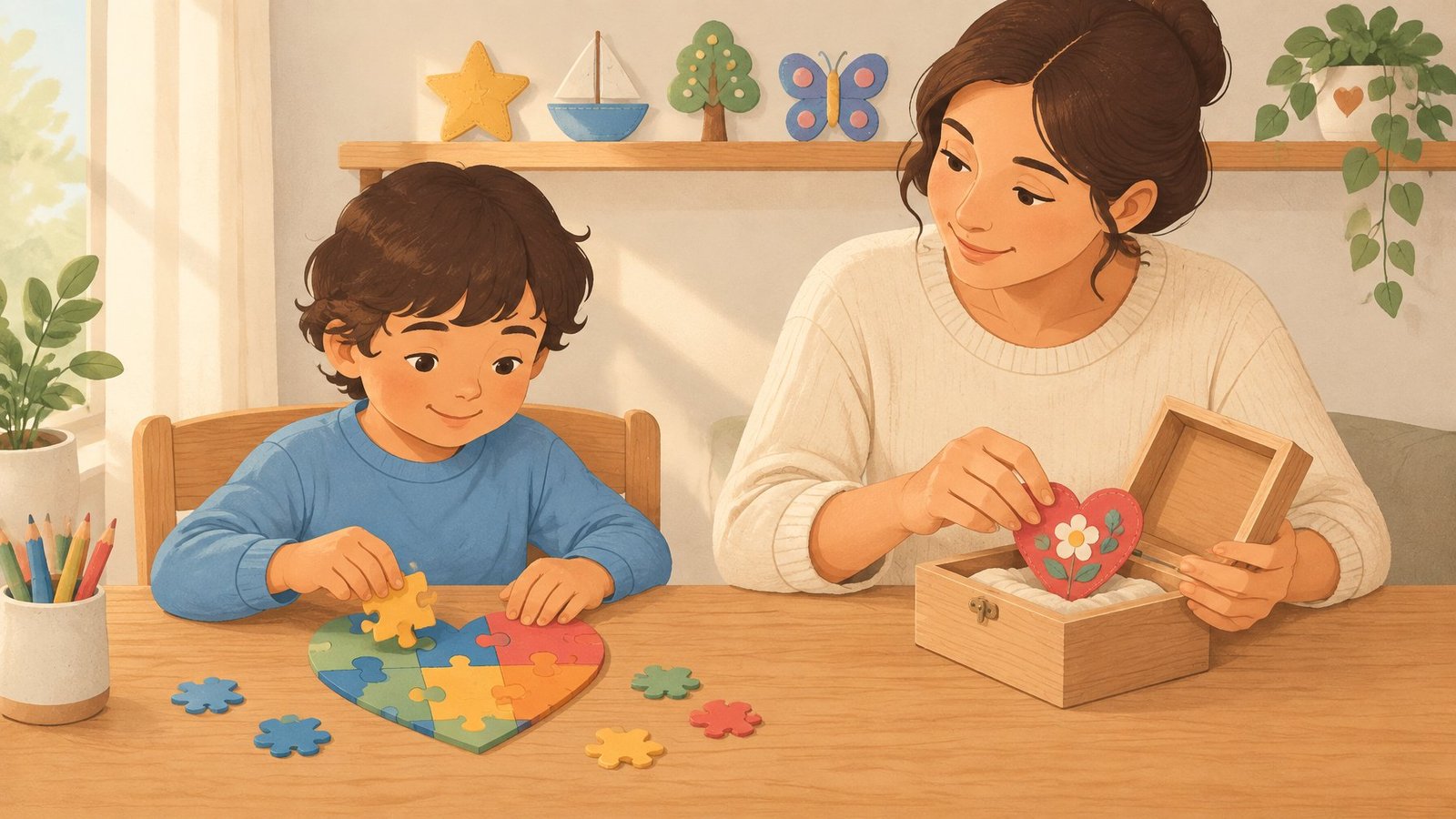
Tell a child that the heart she builds from puzzle pieces will go into a box, and she is far more likely to bother building it. Tell her it will be taken apart, and the easy shortcut starts to look better. Adults behave the same way.
That is the core result of four studies by Yilin Liu of the University of Chicago and the University of Texas at Dallas and Fan Yang of the University of Chicago. The paper was published online in Psychological Science on July 16, 2026.
A heart in a box or a heart taken apart
The researchers tested 604 US children aged 4 to 9 over Zoom, plus 582 adults recruited online. In each version, participants made simple shapes such as hearts or stars from puzzle pieces. The only difference between games was the fate of the result: saved in a box, or taken apart. Nobody was told how long a saved shape would be kept or that they could ever see it again, which made the manipulation deliberately thin.
In a first experiment, 78% to 82% of adults and 69% to 72% of children rated the saving game as better and more meaningful. In a follow-up, when asked which game they wanted to play, about 80% of children and 83% to 90% of adults picked the one where their work was kept. Age made no difference, and the preference held whether the task was repeated or done once.
Paying a sticker to keep a creation
Another experiment added a cost. Normally 85% of children chose a free game over one that cost a sticker. But when only the costly game saved their artwork, that dropped to 50%. Adults showed the same shift. The effect vanished when people merely watched shapes move on screen instead of making them, so it is about one’s own work, not about things being kept in general.
Next the team offered an effortless alternative: drop the pieces straight into the box. When work would be saved, 83% of adults and over 80% of children chose to build the shape. When it would be taken apart, only 34% of adults did. Older children were especially sensitive to the loss.
Fun helps, but only partly
The final study asked whether stressing enjoyment could fill the gap. Reminding participants that the point of the game was to have fun raised building rates, from 69% to 85% among children. Yet even with that reminder, the saved version still motivated more effort than the doomed one.
The authors argue this challenges the view that significance is a late-blooming, adult concern. They describe it as “an essential, early-emerging motivational force.” They note that minimal significance may take other everyday forms, such as photographing a child’s drawing or giving it a name, which they suggest could carry real motivational weight.
Study Details:
- Title: Moved by the Lightest Touch of Meaning: Even Minimal Significance Matters for Motivation From Childhood
- Authors: Yilin Liu, Fan Yang
- Journal: Psychological Science
- Publication Date: July 16, 2026
- DOI: 10.1177/09567976261462874