
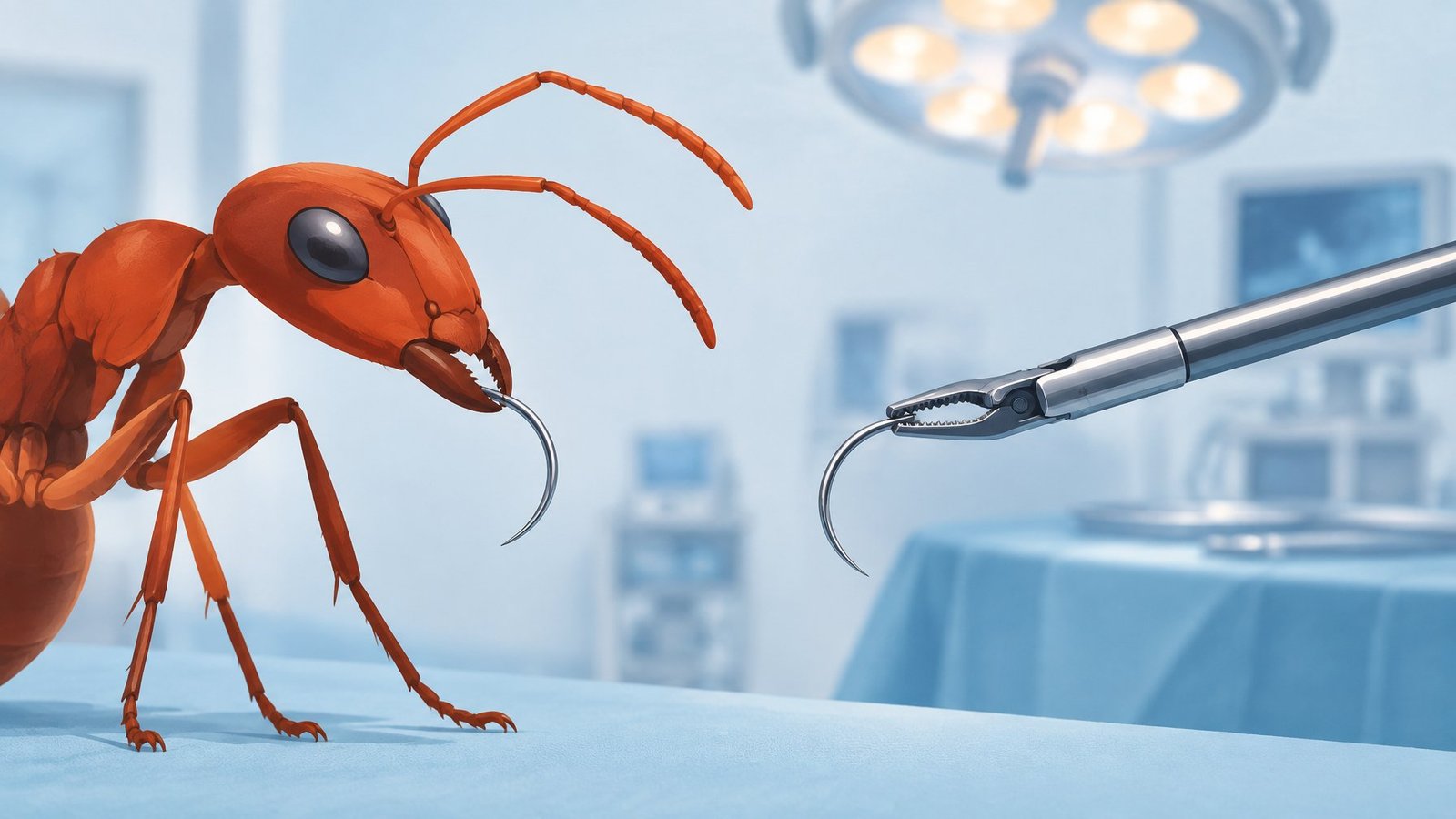
Copying the jaws of the red wood ant made a standard keyhole-surgery needle holder grip far harder. In lab tests with 3D-printed models, the ant-inspired designs held the needle with up to 433% of the original tool’s force transmission, without making the instrument any bigger.
The work was led by zoologist Benjamin Wipfler of the Leibniz Institute for the Analysis of Biodiversity Change in Bonn and pediatric surgeon Carsten Engelmann of University Hospital Brandenburg an der Havel, with engineers from the University of Bayreuth and a physiologist from the University of Rostock. It was published in PNAS on February 12, 2024.
A problem surgeons know well
In endoscopic surgery, stitches are made inside the body with slim needle holders that must pass through small ports. Surgeons routinely see the needle twist or tilt in the jaws, so they have to regrasp it and try again. The authors note this can cost accuracy, cause extra bleeding and add time.
Making the tool bigger is not an option, since a wider instrument means a bigger wound. So the team looked at ants, which carry pine needles and prey with force but also handle their own eggs gently.
Three tricks from the ant’s mandibles
Using micro-CT scans of red wood ants (Formica rufa) collected in a Brandenburg forest, the researchers reconstructed how the mandibles move at five opening positions. Most insects hinge their jaws on two fixed ball-and-socket joints, like a door on two hinges. Ants instead have flat gliding surfaces, so the jaw’s axis of rotation wanders as it opens and closes.
From this they took three design principles: a moving joint axis, a tilted and variable axis, and a changing lever ratio between the closing muscle and the jaw tip. In the ant that ratio ranged from 0.20 to 0.35. The commercial needle holder they started from sits at 0.192, close to the ant’s weakest setting.
Each principle became one redesign of the same commercial instrument, with surface, materials, needle and input force held constant.
- A second rotation axis that slides the jaw as it closes, wedging the needle: 296% calculated, 433% measured.
- A rotation axis tilted 80 degrees so the tool opens sideways and locks the needle like a door wedge: 271% calculated, 394% measured.
- A curved guiding groove instead of a central pin, more than doubling the inner lever from 2.25 to 4.67 millimeters: 2.03 times better calculated, 3.36 times measured.
The groove design also closes 51.9% more slowly, which the authors suggest could give surgeons more control.
Not in an operating room yet
The tests used plastic models printed at ten times scale, and the measured gains ran higher than the calculations, which the authors attribute partly to plastic versus steel and to friction differences. Pushing the designs further would risk jaws that lock shut or close too slowly to suture.
The new designs are also more complex to make than the centuries-old pin hinge, though the authors point out that CNC milling and 3D printing now make them feasible. Their next step is surgical testing of prototypes.
Study Details:
- Title: Understanding the ant’s unique biting system can improve surgical needle holders
- Authors: Benjamin Wipfler, Ole Hoepfner, Felix Viebahn, Tom Weihmann, Frank Rieg, Carsten Engelmann
- Journal: Proceedings of the National Academy of Sciences (PNAS)
- Publication Date: February 12, 2024
- DOI: 10.1073/pnas.2201598121