Ring of Fire: Essential Facts and Recent Developments
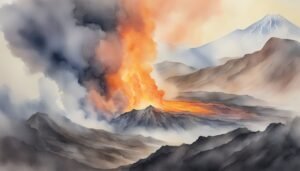
The Ring of Fire, encircling the Pacific Ocean, is notable for hosting 75% of the world's active volcanoes and 90% of its earthquakes due to intense tectonic activity.

The Ring of Fire, encircling the Pacific Ocean, is notable for hosting 75% of the world's active volcanoes and 90% of its earthquakes due to intense tectonic activity.

The Arctic Ocean is the smallest, shallowest, and northernmost ocean, surrounded by various landmasses and connected via the Bering Strait and Greenland Sea.

A tornado is a violently rotating air column from a thunderstorm to the ground, forming under specific atmospheric conditions.

Ecuador is uniquely positioned on the equator, impacting its climate and diverse geography, including mountains, flatlands, and coastlines.
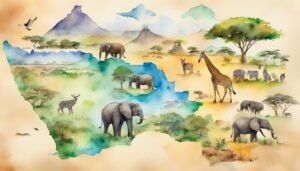
Kenya, located in East Africa, is bordered by five countries and the Indian Ocean, featuring diverse landscapes and a rich historical background.

New Zealand is an island nation in the southwestern Pacific, comprising two main islands and over 700 smaller ones, with diverse landscapes and rich Maori and European heritage.
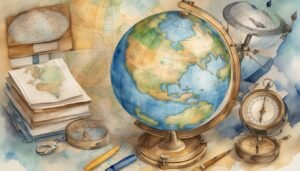
Map projections transform Earth's spherical surface into a flat map, crucial for accurate navigation and educational uses.

Mount Everest, at 8,849m elevation, is the world's highest peak, challenging climbers globally from its position on the China-Nepal border.

The Geologic Time Scale organizes Earth's history into divisions such as eons and epochs, based on rock layers and fossils.

Volcanic lightning, or 'dirty thunderstorm', occurs during eruptions due to charged particles from ash collisions.